
Introduction
Learning a simile for Grade 5 is a great way for students to make their writing more descriptive, creative, and interesting. Instead of simply telling readers that something is fast, bright, loud, soft, or scary, a simile helps them picture the idea by comparing it with something familiar.
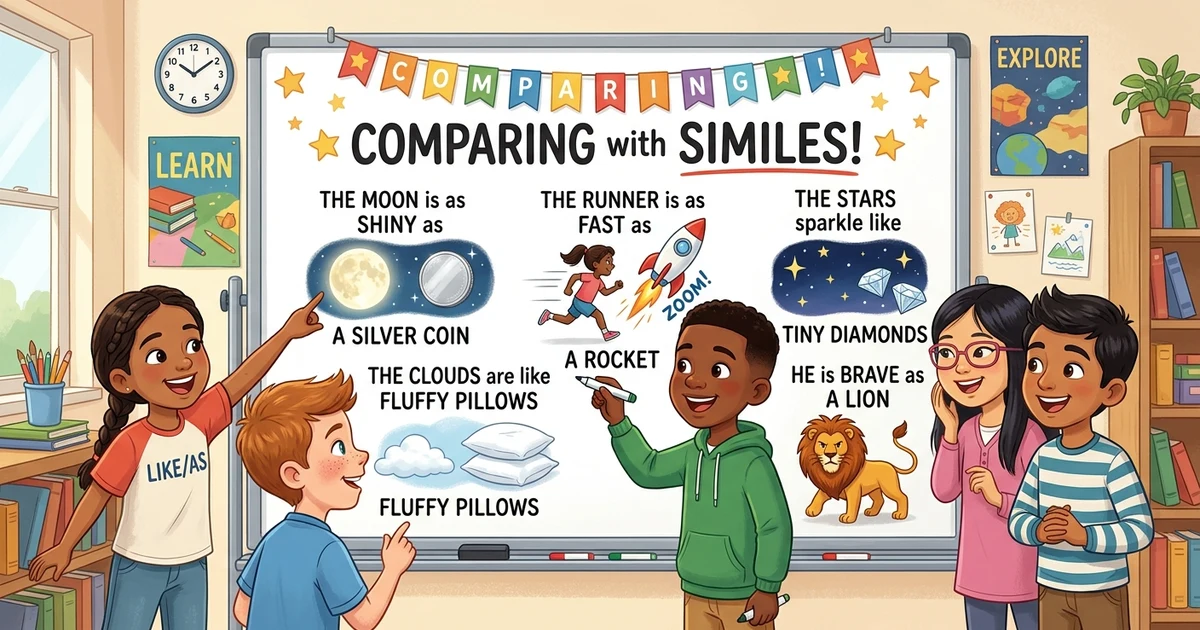
For example, instead of writing, “The runner was very fast,” a student could write, “The runner moved like a rocket.” The runner is not actually a rocket, but the comparison gives readers a stronger idea of how quickly the runner moved.
Similes are especially useful in Grade 5 because students are beginning to write longer stories, personal narratives, poems, reports, and descriptive paragraphs. Learning how to use comparisons effectively can help them add detail without making their writing complicated.
In this guide, you will learn what a simile is, how to recognize one, how to create your own, and how to use similes naturally in Grade 5 writing. You will also find plenty of examples, practice exercises, creative activities, and tips for avoiding common mistakes.
Quick Answer:
A simile for Grade 5 is a comparison between two different things that uses words such as like or as. Writers use similes to help readers imagine a person, object, place, feeling, sound, or action more clearly.
For example:
- The clouds looked like fluffy pillows.
- The water was as cold as ice.
- The little boy ran like the wind.
- Her eyes sparkled like tiny stars.
- The classroom was as busy as a beehive.
A simile does not mean that the two things are literally the same. It simply points out a quality they share.
What Is a Simile?
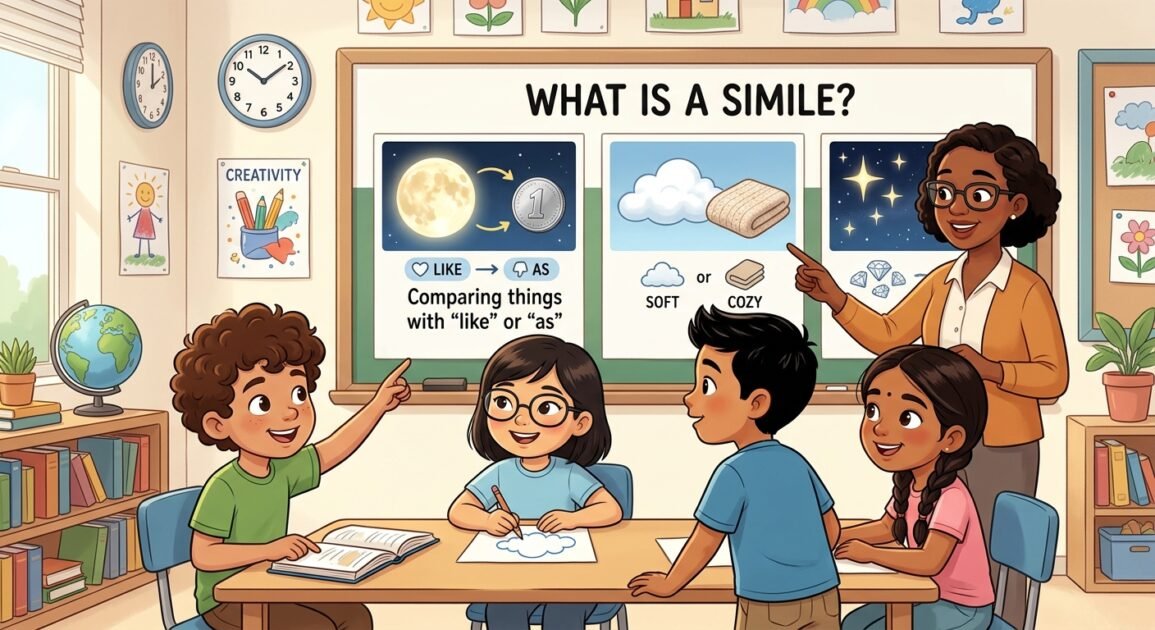
A simile is a figure of speech that compares two different things using a comparison word, usually like or as.
Consider this sentence:
The moon looked like a silver coin.
The moon is not actually a coin. The writer compares the moon with a silver coin because both can appear round, bright, and silver.
Here is another example:
The blanket was as soft as a cloud.
A blanket is not a cloud. The comparison helps readers imagine that the blanket felt very soft.
A good simile has a clear purpose. It should help the reader understand, visualize, or feel something more strongly.
The Basic Pattern of a Simile
A simple simile can follow patterns such as:
Something + is + like + something else
The lake was like a mirror.
Or:
Something + is + as + quality + as + something else
The lake was as smooth as glass.
Both structures make a comparison clear.
Why Do Grade 5 Students Need to Learn Similes?
Similes are useful because they give students another way to express ideas. Instead of relying on basic adjectives such as big, fast, beautiful, or loud, students can create more vivid descriptions.
Using similes can help Grade 5 students:
- Make stories more interesting.
- Improve descriptive writing.
- Explain feelings more clearly.
- Create stronger mental images.
- Develop creative thinking.
- Practice figurative language.
- Add detail to poems and narratives.
- Expand their vocabulary.
- Make ordinary sentences more memorable.
For example:
Simple:
The rain was heavy.
With a simile:
The rain fell like a curtain of water.
The second sentence gives readers a clearer picture of the rain.
How to Identify a Simile
Recognizing a simile becomes easier when you follow a few simple steps.
1. Find the Comparison
Look for two different things being connected.
The river flowed like a silver ribbon.
The river and a ribbon are two different things.
2. Look for a Comparison Word
Similes commonly use like or as.
Examples:
- The stars shone like diamonds.
- He was as quiet as a mouse.
But simply finding like or as is not enough.
3. Check Whether the Word Shows a Comparison
Consider:
I like strawberries.
This is not a simile because like expresses a preference. Nothing is being compared.
Now consider:
The strawberries were like tiny red jewels.
This is a simile because strawberries are being compared with jewels.
4. Ask What Quality the Comparison Shows
A useful question is:
What do these two things have in common?
In:
The puppy bounced like a rubber ball.
The puppy and rubber ball are compared because both can bounce.
Easy Simile Examples for Grade 5
Here are examples organized by topic so students can see how similes work in different kinds of writing.
Similes About School
- The classroom was as quiet as a library.
- The hallway was as busy as a train station.
- My backpack felt as heavy as a suitcase.
- The students rushed outside like a flock of birds.
- Her pencil moved like a tiny racing car across the page.
- The school bell rang like an alarm clock.
Similes About Animals
- The puppy was as playful as a kitten.
- The fox moved like a shadow through the forest.
- The horse ran like the wind.
- The kitten was as quiet as a whisper.
- The eagle soared like a glider.
- The turtle moved as slowly as a drifting cloud.
About Nature
- The river curved like a silver ribbon through the valley.
- The stars glittered like tiny lanterns.
- The flowers swayed like dancers in the breeze.
- The trees stood like silent guards.
- The leaves floated like little boats on the water.
- The moon hung in the sky like a glowing lantern.
About Weather
- The snow covered the ground like a white blanket.
- The wind rushed through the trees like a speeding train.
- The rain tapped on the roof like tiny fingers.
- The lightning flashed like a camera.
- The clouds gathered like a dark army across the sky.
- The thunder rolled like giant drums.
Simile About Food
- The popcorn was as light as a feather.
- The cake was as sweet as honey.
- The cookies were as crunchy as autumn leaves.
- The lemonade tasted as refreshing as a cool breeze.
- The soup was as warm as a cozy blanket.
- The watermelon was as juicy as a summer afternoon.
Personality
- She was as cheerful as a sunny morning.
- He was as brave as a lion.
- She was as gentle as a summer breeze.
- He was as curious as a cat.
Movement
- The athlete moved like a lightning bolt.
- The children rushed toward the playground like excited birds.
- She danced like a leaf floating on water.
- He jumped like a spring.
Appearance
- Her eyes sparkled like stars.
- His hair was as soft as silk.
- Her smile was like sunshine after rain.
- The baby’s cheeks were as smooth as peaches.
The strongest simile depends on the exact detail the writer wants readers to notice.
Simile vs. Metaphor
Similes and metaphors are both types of figurative language, but they make comparisons differently.
| Simile | Metaphor |
|---|---|
| Uses like or as | Makes a direct comparison |
| The moon was like a silver coin. | The moon was a silver coin. |
| She ran like the wind. | She was the wind on the track. |
| The clouds looked like cotton. | The clouds were cotton in the sky. |
Easy Way to Remember
A simile says something is like something else.
A metaphor says something is something else.
For Grade 5 students, looking for a comparison made with like or as is a useful first step when identifying a simile.
Simile vs. Literal Language
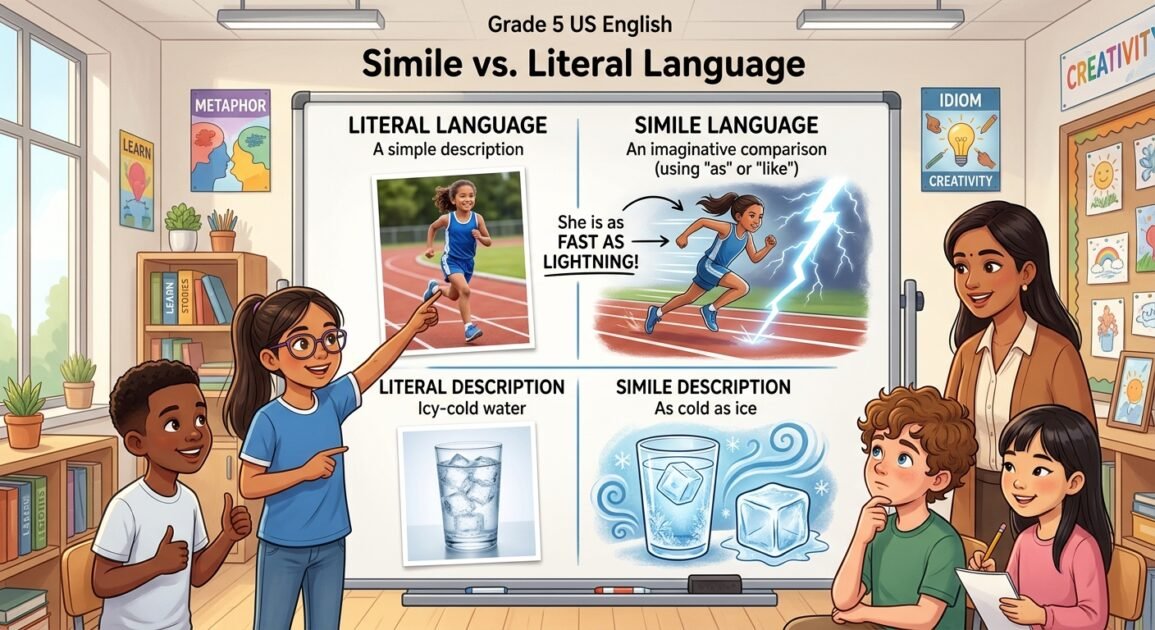
A simile is not meant to be understood literally.
For example:
The runner was as fast as lightning.
The runner is not actually lightning. The writer is comparing the runner’s speed with the incredible speed associated with lightning.
Compare:
Literal:
The runner was very fast.
Figurative:
The runner was as fast as lightning.
The figurative sentence creates a stronger image.
How to Write Your Own Simile
Creating an original simile is easier when you break the process into steps.
Step 1: Choose Something to Describe
Pick a person, place, object, action, sound, or feeling.
Example:
A runner
Step 2: Decide What You Want to Show
Ask what quality stands out.
Fast
Step 3: Think of Something With the Same Quality
You could choose:
- A rocket
- Lightning
- The wind
- A racing car
Step 4: Connect the Two Ideas
Use like or as.
The runner moved like the wind.
Or:
The runner was as fast as a rocket.
Step 5: Test Your Simile
Ask yourself:
- Does the comparison make sense?
- Is the shared quality clear?
- Does it help readers imagine the idea?
- Does it sound natural?
- Does it add something useful?
If yes, your simile is probably working well.
Turn Simple Sentences Into Similes
One of the easiest ways to practice is to improve ordinary sentences.
Example 1
Simple:
The puppy was energetic.
With a simile:
The puppy bounced around like a rubber ball.
Example 2
Simple:
The stars were bright.
With a simile:
The stars glittered like tiny diamonds.
Example 3
Simple:
The pillow was soft.
With a simile:
The pillow was as soft as a cloud.
Example 4
Simple:
The boy was nervous.
With a simile:
The boy shook like a leaf before the speech.
This type of exercise teaches students how figurative language can strengthen ordinary writing.
Simile Writing Practice
Complete each sentence with a creative comparison.
- The puppy was as playful as __________.
- The stars looked like __________.
- The snow was as white as __________.
- My backpack felt as heavy as __________.
- The runner moved like __________.
- The classroom was as busy as __________.
- Her smile was like __________.
- The clouds looked like __________.
- The water was as cold as __________.
- The little bird flew like __________.
There is not always one correct answer. Students should choose comparisons that make sense and clearly communicate an idea.
Fill-in-the-Blank Simile Quiz
Choose the best answer.
1. As busy as a ______.
- bee
- pillow
- rock
Answer: bee
2. As quiet as a ______.
- mouse
- drum
- thunderstorm
Answer: mouse
3. Ran like the ______.
- wind
- table
- pencil
Answer: wind
4. As cold as ______.
- ice
- bread
- paper
Answer: ice
5. As light as a ______.
- feather
- mountain
- truck
Answer: feather
These familiar comparisons help students understand the relationship between a quality and the thing used to describe it.
Fun Simile Activities for Grade 5
1. Simile Match Game
Prepare two sets of cards.
Quality cards:
- Bright
- Soft
- Fast
- Quiet
- Busy
Comparison cards:
- Sun
- Feather
- Rocket
- Mouse
- Bee
Students match a quality with a suitable comparison and then turn it into a complete simile.
For example:
Bright + sun
The stars were as bright as the sun.
Teachers can also encourage students to find more creative matches instead of using only the obvious answers.
2. Finish the Simile
Write the beginning of a simile on the board:
- As bright as __________.
- As soft as __________.
- As cold as __________.
- Ran like __________.
- Shone like __________.
Let students create their own endings.
This activity works especially well because there can be several reasonable answers.
3. Draw a Simile
Ask students to draw a picture based on a simile.
For example:
The moon looked like a silver coin.
Students can draw the moon beside a silver coin to show the comparison visually.
4. Simile Story Challenge
Ask students to write a short story or paragraph containing at least three similes.
Possible topics include:
- A rainy school morning
- A trip to the beach
- A mysterious forest
- A family celebration
- A day at the amusement park
- A surprising adventure
The goal is to use similes naturally rather than simply inserting them into random sentences.
5. Simile Scavenger Hunt
Give students a book, short story, or classroom passage and ask them to find examples of similes.
For every simile they find, they can record:
- The thing being described.
- The comparison.
- The word connecting them.
- The quality being shown.
This activity helps students recognize figurative language in real reading material.
Write a Paragraph Using Similes
Compare these two versions.
Without Similes
The storm arrived at night. The wind was strong. The rain was heavy. The trees moved in the wind.
With Similes
The storm arrived at night like a dark curtain covering the town. The wind howled like a wild wolf, while rain tapped against the windows like tiny drums. The trees bent and swayed like dancers caught in a powerful breeze.
The second paragraph creates a stronger picture because each comparison adds a specific detail.
However, good writing does not require a simile in every sentence. A few well-chosen comparisons are often more effective than too many.
Common Mistakes When Using Similes
1. Confusing a Simile With a Metaphor
Metaphor:
The classroom was a zoo.
Simile:
The classroom was like a zoo.
Both compare the classroom with a zoo, but only the second uses a simile.
2. Assuming Every “Like” Is a Simile
I like pizza.
This is not a simile because like shows a preference.
The pizza looked like a golden wheel.
This is a simile because a comparison is being made.
3. Making a Comparison That Does Not Make Sense
A simile should have a logical connection.
Weak:
The pencil was like the moon because it was delicious.
The comparison does not communicate a clear quality.
Better:
The pencil was as sharp as a needle.
4. Using Too Many Similes
Adding a simile to every sentence can make writing feel crowded.
Instead, choose comparisons that add an important image or detail.
5. Relying Only on Common Clichés
Common similes are useful for beginners, but students should also experiment with original ideas.
Instead of always writing:
She was as busy as a bee.
Try:
She darted around the classroom like a hummingbird among flowers.
Original comparisons can make a student’s writing more memorable.
Tips for Writing Stronger Similes
Use these tips whenever you create a new simile:
- Think about the exact quality you want to describe.
- Choose a comparison readers can understand.
- Make sure the two things share a meaningful quality.
- Avoid comparisons that distract from your main idea.
- Try unusual but logical comparisons.
- Use similes where they add value.
- Read the sentence aloud to check how naturally it sounds.
- Do not force a simile just because an assignment requires one.
A strong simile should make the reader think, “I can picture that.”
Similes in Everyday English
Students may hear familiar similes in books, conversations, songs, movies, and classroom discussions.
Some common examples include:
- As light as a feather
- As busy as a bee
- As cool as a cucumber
- As free as a bird
- As hungry as a wolf
- Fits like a glove
- Sleeps like a baby
- Runs like the wind
- Shines like the sun
- Works like a machine
Learning these expressions can help students recognize figurative language outside the classroom.
Conclusion
Learning a simile for Grade 5 gives students a simple but powerful way to make their writing more descriptive and creative. By comparing one thing with another using like or as, students can help readers picture characters, settings, emotions, sounds, and actions.
The best similes are clear, meaningful, and relevant to the idea being described. Students can begin with familiar comparisons such as as light as a feather or runs like the wind, then gradually create their own original comparisons.
The most important thing is to practice. Try turning simple sentences into similes, complete unfinished comparisons, identify similes in stories, and write short paragraphs using figurative language. With regular practice, Grade 5 students can use similes naturally to make their stories, poems, and descriptive writing more vivid and enjoyable.
Frequently Asked Questions
What is a simile for Grade 5?
A simile for Grade 5 is a comparison between two different things that usually uses like or as. It helps readers understand or imagine an idea more clearly.
For example:
The clouds looked like fluffy pillows.
What is an easy example of a simile?
An easy example is:
The baby was as quiet as a mouse.
The comparison shows that the baby was very quiet.
What are the main parts of a simile?
A basic simile contains the thing being described, a comparison, and a word such as like or as.
For example:
The moon was like a silver coin.
The moon is the subject, silver coin is the comparison, and like connects the two.
How do I make my own simile?
Choose something you want to describe, identify its most important quality, think of something else with that quality, and connect the ideas using like or as.
Can a simile use “like” and “as”?
Yes. Both are commonly used.
Like:
The river moved like a ribbon.
As:
The river was as smooth as glass.
Why do writers use similes?
Writers use similes to make descriptions clearer, more vivid, and more memorable. A good simile helps readers create a mental picture of what the writer is describing.
What is the difference between a simile and a metaphor?
A simile uses like or as to compare two things.
The moon was like a lamp.
A metaphor makes a direct comparison.
The moon was a lamp.
Is every sentence with “like” a simile?
No. The word like must introduce a comparison.
I like chocolate.
This is not a simile.
The chocolate looked like a shiny brown treasure.
This is a simile because two things are being compared.
Can similes describe feelings?
Yes. Similes are especially useful for describing emotions.
For example:
She was as nervous as a bird before its first flight.
The comparison gives readers a better sense of the character’s nervousness.
Can I use more than one simile in a paragraph?
Yes, but use them carefully. A few strong similes can make a paragraph vivid, while too many may make the writing feel crowded.
