Introduction
Learning to write is an exciting part of second grade. Children begin turning simple ideas into stories, descriptions, and short paragraphs. At this stage, they also learn how to make their writing more interesting by adding descriptive words.
One fun way to do this is by learning similes.
Compare these two sentences:
The puppy was soft.
The puppy was as soft as a fluffy cloud.
Both sentences tell us that the puppy was soft, but the second sentence gives us a clearer picture. We can imagine something soft and fluffy.
That is what a simile does. It helps readers picture an idea by comparing one thing with another familiar thing. For Grade 2 students, similes are easy to learn because they often use the words “like” or “as.”
This guide explains what a simile for Grade 2 means, shows easy examples, and provides simple activities and writing tips that children, parents, and teachers can use.
Quick Answer
A simile for Grade 2 is a comparison between two different things using “like” or “as.” Similes make writing more descriptive and help readers imagine what something looks, sounds, feels, or moves like. For example, “The kitten was as soft as a pillow” is a simile because it compares the kitten’s softness to a pillow. Second graders can learn similes by spotting comparison words, matching examples, completing sentences, and creating their own comparisons.
What Is a Simile?
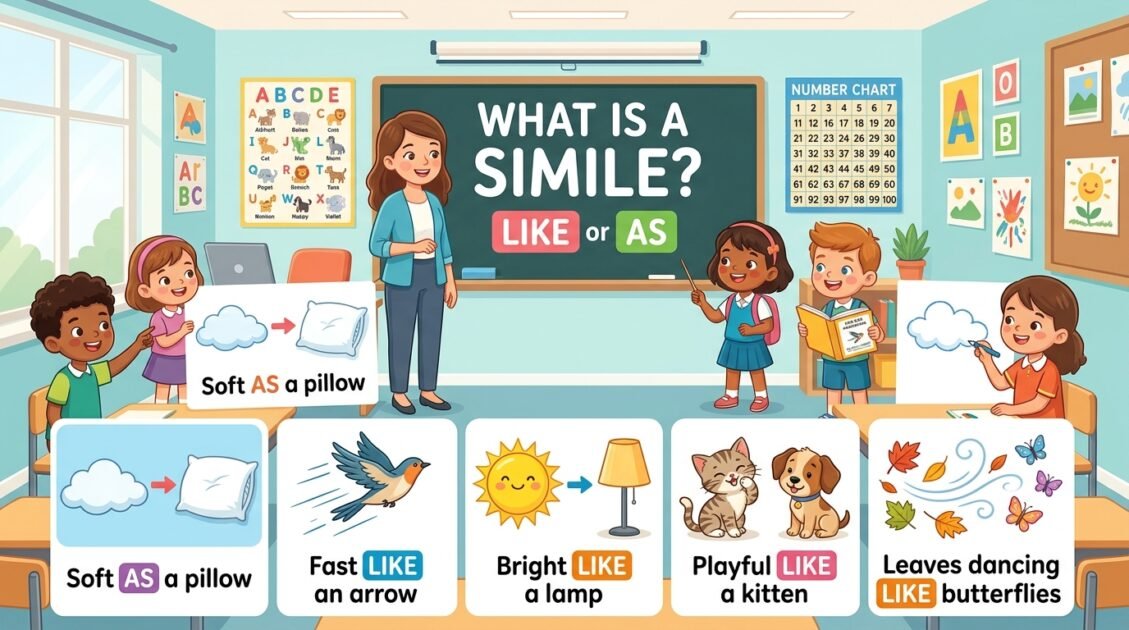
A simile is a figure of speech that compares two different things using “like” or “as.”
The comparison helps explain an idea in a way that is easy to imagine.
For example:
The snow was white.
This sentence gives us information, but it does not create a strong picture.
Now look at:
The snow was as white as a sheet of paper.
The comparison helps us imagine how white the snow looked.
Here is another example:
The boy ran quickly.
A more colorful sentence is:
The boy ran like the wind.
The boy is not actually the wind. The sentence compares his speed with the speed of the wind.
Easy Rule to Remember
Simile = comparison + “like” or “as”
For example:
- The pillow was as soft as a cloud.
- The bird flew like an arrow.
- The sun was as bright as a lamp.
Why Are Similes Useful for Grade 2 Students?
Similes help children move beyond very simple descriptions.
Instead of writing:
The flower was pretty.
A student can write:
The flower was as colorful as a rainbow.
The second sentence gives the reader more to imagine.
Learning similes can help Grade 2 students:
- Add details to their writing
- Build vocabulary
- Practice descriptive language
- Develop creativity
- Understand comparisons
- Make stories more interesting
- Express ideas more clearly
- Notice how authors use language
Similes can also make reading more enjoyable. When children find a simile in a story, they can stop and think about the picture the writer is creating.
How to Recognize a Simile
A simple way to spot a simile is to look for “like” or “as.”
Examples:
- The kitten was as soft as a pillow.
- The stars shone like tiny lights.
- The classroom was as quiet as a library.
- The runner moved like the wind.
Then ask:
“Is the sentence comparing two different things?”
If it is, you probably found a simile.
Remember: Not Every “Like” Is a Simile
The word “like” does not automatically make a sentence a simile.
For example:
I like chocolate.
There is no comparison here. The word “like” simply tells us what the person enjoys.
But:
The chocolate was as smooth as silk.
This sentence makes a comparison, so it is a simile.
Parts of a Simile
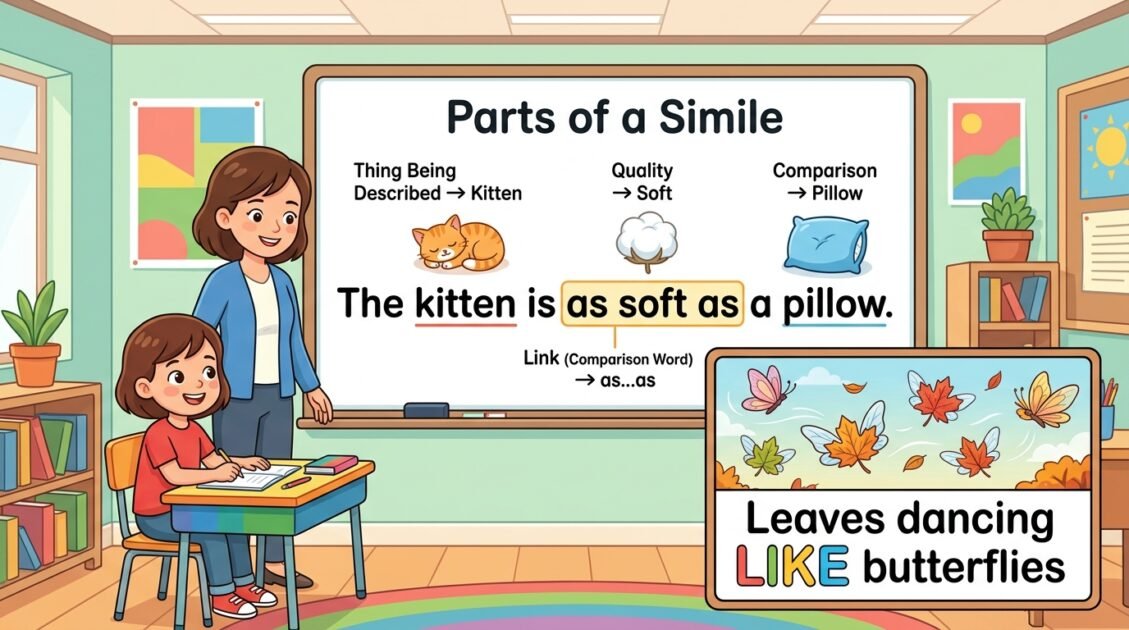
A simile usually has three important parts:
| Part | Example |
|---|---|
| Thing being described | The kitten |
| Quality | Soft |
| Comparison | A pillow |
Together, they make:
The kitten was as soft as a pillow.
Another example:
The leaves danced like butterflies.
Here:
- Thing being described: leaves
- Action: danced
- Comparison: butterflies
Understanding these parts helps children create their own similes.
Easy Similes for Grade 2
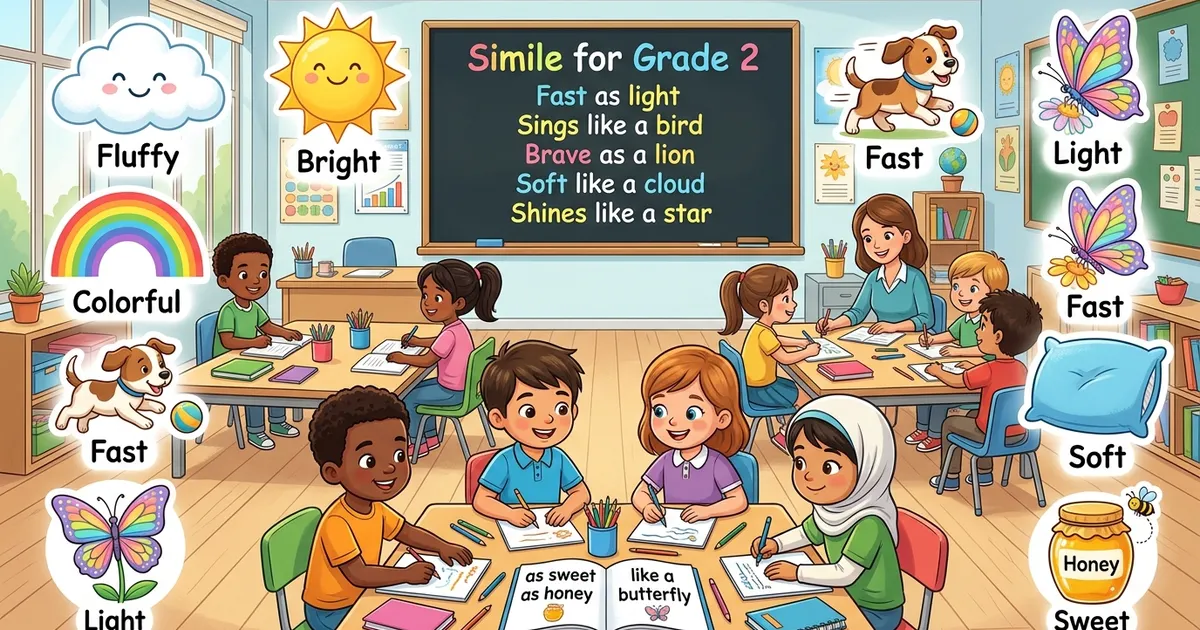
Here are simple similes that second graders can easily understand:
| Simile | Meaning |
|---|---|
| As busy as a bee | Very busy |
| As quiet as a mouse | Very quiet |
| As bright as the sun | Very bright |
| As soft as a pillow | Very soft |
| As sweet as honey | Very sweet |
| As light as a feather | Very light |
| As fast as a rabbit | Very fast |
| As colorful as a rainbow | Full of colors |
| As fluffy as a cloud | Very fluffy |
| As strong as a horse | Very strong |
| As brave as a lion | Very brave |
| As wise as an owl | Very wise |
| As slow as a turtle | Very slow |
| As gentle as a lamb | Very gentle |
| As cool as a breeze | Pleasantly cool |
Animal Similes
Animals are excellent choices for young learners because children already know many common animal traits.
- As brave as a lion — The firefighter was as brave as a lion.
- As busy as a bee — Mom was as busy as a bee in the kitchen.
- As quiet as a mouse — The children were as quiet as mice during the story.
- As playful as a puppy — The kitten was as playful as a puppy.
- As gentle as a lamb — The girl was as gentle as a lamb with the baby bird.
- As clever as a fox — Noah was as clever as a fox when solving the puzzle.
- As quick as a rabbit — Mia was as quick as a rabbit during the game.
- As graceful as a swan — The dancer moved as gracefully as a swan.
- As colorful as a peacock — Her costume was as colorful as a peacock.
- As curious as a kitten — Lily was as curious as a kitten.
- As wise as an owl — Grandpa was as wise as an owl.
- As slow as a turtle — The little turtle moved as slowly as a turtle.
Nature Similes
Nature gives children many familiar things to use in comparisons.
- As bright as the sun — The morning was as bright as the sun.
- As blue as the sky — The lake was as blue as the sky.
- As white as snow — The rabbit was as white as snow.
- As green as grass — The field was as green as grass.
- As calm as a quiet lake — The pond was as calm as a quiet lake.
- As light as a feather — The leaf was as light as a feather.
- As warm as sunshine — The blanket felt as warm as sunshine.
- As cool as a gentle breeze — The evening air was as cool as a gentle breeze.
- As colorful as a rainbow — The garden was as colorful as a rainbow.
- As golden as autumn leaves — The trees looked as golden as autumn leaves.
- As fresh as spring rain — The air smelled as fresh as spring rain.
- As peaceful as a sunset — The beach looked as peaceful as a sunset.
Food Similes
Food is another easy source of comparisons because children can describe taste, texture, color, and appearance.
- As sweet as honey — The candy was as sweet as honey.
- As soft as a marshmallow — The cake was as soft as a marshmallow.
- As round as a cookie — The moon looked as round as a cookie.
- As red as a strawberry — The apple was as red as a strawberry.
- As smooth as pudding — The pudding was as smooth as pudding.
- As crunchy as crackers — The carrots were as crunchy as crackers.
- As fluffy as whipped cream — The kitten’s fur was as fluffy as whipped cream.
- As golden as toast — The bread was as golden as toast.
- As juicy as a watermelon — The peach was as juicy as a watermelon.
- As warm as fresh bread — The rolls were as warm as fresh bread.
- As colorful as candy — The decorations were as colorful as candy.
- As creamy as ice cream — The dessert was as creamy as ice cream.
School Similes
School is full of familiar objects and experiences that children can use to make comparisons.
- As straight as a ruler — The line was as straight as a ruler.
- As sharp as a pencil — My pencil was as sharp as a pencil can be.
- As colorful as crayons — The drawing was as colorful as a box of crayons.
- As neat as a new notebook — Her handwriting was as neat as a new notebook.
- As quiet as a library — The classroom was as quiet as a library.
- As bright as a classroom light — The room was as bright as a classroom light.
- As clean as a new desk — His desk was as clean as a new desk.
- As full as a school bus — The bus was as full as a school bus could be.
- As organized as a bookshelf — Her books were as organized as a bookshelf.
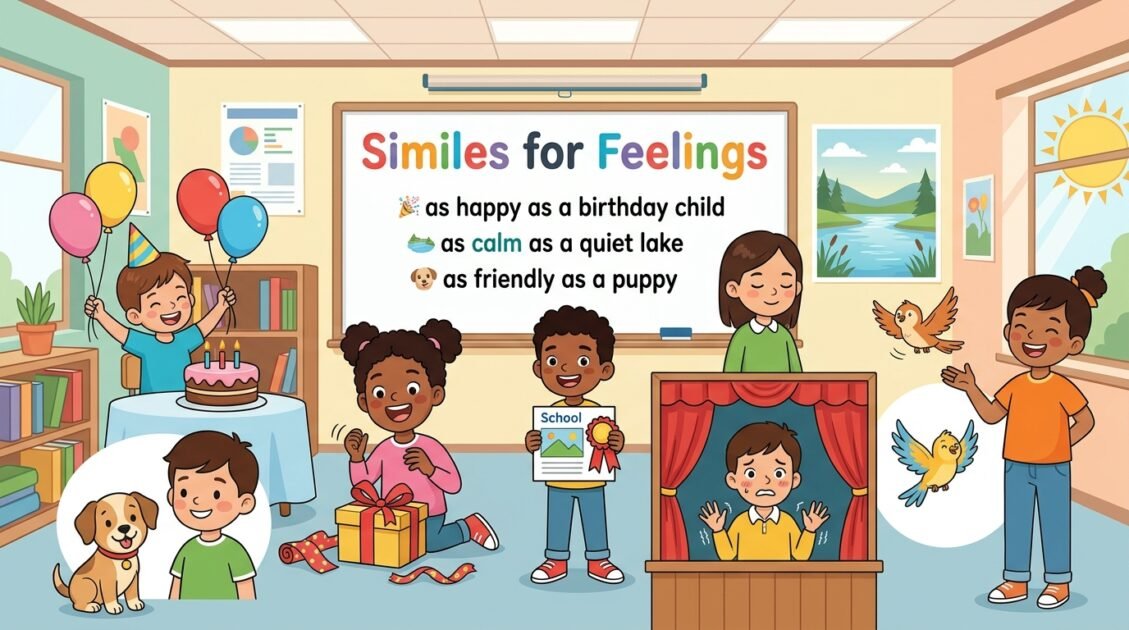
Similes for Feelings
Similes can help children describe emotions instead of simply saying happy, sad, or nervous.
- As happy as a child on a birthday — Mia was as happy as a child on a birthday.
- As excited as a child opening a gift — Ben was as excited as a child opening a gift.
- As proud as a winner — Sara felt as proud as a winner after her performance.
- As calm as a quiet lake — Ali felt as calm as a quiet lake.
- As nervous as a mouse — Tom felt as nervous as a mouse before the play.
- As cheerful as sunshine — Grandma was as cheerful as sunshine.
- As friendly as a puppy — Our new classmate was as friendly as a puppy.
- As surprised as a child finding a treasure — Emma was as surprised as a child finding treasure.
- As joyful as a bird — The children were as joyful as birds in spring.
Weather Similes
Weather can make descriptions more vivid.
- As bright as the summer sun
- As cold as winter snow
- As cool as a morning breeze
- As gentle as spring rain
- As loud as rolling thunder
- As dark as a storm cloud
- As clear as a sunny day
- As fresh as morning air
- As warm as a sunny afternoon
- As quiet as falling snow
Example:
The rain fell as gently as a soft whisper.
Similes With “Like”
Not all similes use “as.” Many use “like.”
Examples:
- The baby slept like a log.
- The leaves danced like butterflies.
- The puppy jumped like a spring.
- The stars twinkled like tiny lights.
- The boy ran like the wind.
- The clouds floated like cotton balls.
- The fish moved like a silver arrow.
- The children laughed like birds.
These comparisons help readers imagine movement, sounds, and actions.
How to Write Your Own Simile
Creating a simile can be easy when you follow four steps.
Step 1: Choose Something
Pick something you want to describe.
For example:
A puppy
Step 2: Think of Its Quality
Ask what it is like.
A puppy might be:
- Soft
- Playful
- Small
- Fast
- Friendly
Let’s choose soft.
Step 3: Think of Something Else That Is Soft
You could choose:
A pillow
Step 4: Add “Like” or “As”
Now put the ideas together:
The puppy was as soft as a pillow.
That’s a simile!
Easy Simile Formulas
Children can use these patterns when they are learning.
Formula 1
Something + is/was + as + quality + as + comparison
Example:
The kitten was as soft as a pillow.
Formula 2
Something + action + like + comparison
Example:
The leaves danced like butterflies.
Formula 3
Something + looks/sounds/feels + like + comparison
Example:
The clouds looked like cotton balls.
These patterns give young writers a simple starting point without limiting their creativity.
Fun Simile Activities for Grade 2
1. Simile Matching Game
Write the first and second parts of similes on separate cards.
For example:
As busy as → a bee
As soft as → a pillow
As bright as → the sun
As quiet as → a mouse
Mix the cards and let students find the matching pairs.
2. Finish the Simile
Complete each sentence:
- The kitten was as soft as a ______.
- The runner moved like the ______.
- The candy was as sweet as ______.
- The classroom was as quiet as a ______.
- The rainbow was as colorful as ______.
Possible answers:
- Pillow
- Wind
- Honey
- Mouse
- A box of crayons
Children can also create their own answers if the comparison makes sense.
3. Draw the Simile
Give students a simile and ask them to draw what it describes.
Example:
The cloud was as fluffy as cotton.
The child can draw a fluffy cloud and cotton beside it.
This activity connects language with visual thinking.
4. Simile Scavenger Hunt
Ask students to look for similes in books, poems, or classroom reading materials.
When they find one, they can:
- Write the simile.
- Circle like or as.
- Identify the two things being compared.
- Explain what the comparison means.
5. Make a Simile Book
Students can create a small book called “My Simile Book.”
Each page can contain one simile and a drawing.
For example:
Page 1: My puppy is as soft as a pillow.
Page 2: The clouds look like cotton balls.
This gives children a fun way to practice writing and illustration together.
6. Classroom Object Challenge
Choose an object in the classroom and ask students to describe it with a simile.
For example:
A pencil is as straight as a ruler.
The paper is as white as snow.
The classroom is as quiet as a library.
There is no need for every student to give the same answer. Creative comparisons are part of the fun.
Simile Practice for Grade 2
Choose the best answer.
1. The baby was as quiet as a ______.
a. mouse
b. drum
c. train
2. The candy was as sweet as ______.
a. honey
b. grass
c. rain
3. The runner moved like the ______.
a. wind
b. chair
c. book
4. The snow was as white as ______.
a. paper
b. coal
c. mud
5. The puppy was as playful as a ______.
a. puppy
b. rock
c. table
Answers
- a. mouse
- a. honey
- a. wind
- a. paper
- a. puppy
Create Your Own Similes
Now it is your turn!
Complete these sentences with your own ideas:
- The sun was as bright as ______.
- The kitten was as soft as ______.
- The boy ran like ______.
- The flower was as colorful as ______.
- The rain sounded like ______.
- The cake was as sweet as ______.
- The classroom was as quiet as ______.
- The clouds looked like ______.
There can be more than one correct answer. The goal is to create a comparison that makes sense and helps the reader imagine the idea.
Common Simile Mistakes
1. Using “Like” Without a Comparison
Not a simile:
I like apples.
The word “like” shows preference, not comparison.
Simile:
The apple was as red as a ruby.
2. Forgetting the Comparison Word
Not a simile:
The kitten was a cloud.
This is a metaphor.
Simile:
The kitten was as fluffy as a cloud.
3. Using a Confusing Comparison
A good Grade 2 simile should be easy to understand.
Too difficult:
The flower was as beautiful as a rare masterpiece.
Better:
The flower was as colorful as a rainbow.
4. Making the Simile Too Long
Young writers usually do better with short, clear comparisons.
Too long:
The puppy was as soft as the blanket my grandmother gave me last Christmas.
Better:
The puppy was as soft as a blanket.
5. Choosing a Comparison That Does Not Match
Make sure the comparison shares the quality you are describing.
For example:
The feather was as heavy as a truck.
This does not make sense because a feather is light, not heavy.
A better sentence is:
The feather was as light as a leaf.
Tips for Parents and Teachers
Adults can make learning similes simple and enjoyable.
Use Familiar Things
Children understand comparisons better when they know both things being compared.
Try:
- Pillow
- Cloud
- Sun
- Rainbow
- Mouse
- Puppy
- Honey
- Snow
- Feather
Ask Simple Questions
Instead of giving children all the answers, ask:
“What is something very soft?”
“What moves very fast?”
Their answers can become the building blocks for similes.
Let Children Draw
Drawing a simile can help children understand the comparison.
For example:
The clouds looked like cotton balls.
Ask the child to draw both the clouds and cotton balls.
Accept Creative Answers
There is often more than one good answer.
For:
The puppy was as soft as ______.
A child might say:
- A pillow
- A cloud
- A blanket
- Cotton
If the comparison makes sense, encourage the idea.
Practice in Everyday Conversation
Similes do not have to stay on worksheets.
While walking outside, ask:
“What does that cloud look like?”
A child might answer:
“It looks like a giant cotton ball.”
That is a natural way to practice descriptive language.
Simile vs. Metaphor
Second graders may sometimes confuse similes with metaphors.
The easiest difference is:
| Simile | Metaphor |
|---|---|
| Uses “like” or “as” | Does not use “like” or “as” |
| Makes a comparison | Makes a direct comparison |
| The cloud looks like cotton. | The cloud is cotton. |
| The kitten is as soft as a pillow. | The kitten is a pillow. |
Easy Tip
If “like” or “as” connects the comparison, it is usually a simile.
Why Similes Matter in Writing
Similes are more than a grammar exercise. They teach children how to choose words carefully.
Compare:
The dog was fast.
with:
The dog ran like the wind.
The second sentence gives the reader a stronger image.
This skill can help children later write:
- Better stories
- More detailed paragraphs
- Interesting poems
- Creative descriptions
- Stronger personal narratives
The goal is not to make every sentence complicated. Instead, students should learn when a comparison can make an idea clearer or more interesting.
Frequently Asked Questions
What is a simile for Grade 2?
A simile for Grade 2 is a simple comparison between two different things using “like” or “as.” For example, “The kitten was as soft as a pillow.”
What is an easy simile for a second grader?
An easy example is:
The baby was as quiet as a mouse.
It uses “as” to compare the baby’s quietness with a mouse.
What are five simple similes?
Five easy similes are:
- As busy as a bee.
- As quiet as a mouse.
- As soft as a pillow.
- As bright as the sun.
- As sweet as honey.
How do you teach similes to Grade 2 students?
Start with familiar objects and explain that a simile compares two different things using “like” or “as.” Then use pictures, matching games, sentence completion, drawing activities, and short writing exercises.
What is a simile example using “like”?
The leaves danced like butterflies.
The sentence compares the movement of leaves with butterflies.
What is a simile example using “as”?
The kitten was as soft as a pillow.
The sentence compares the kitten’s softness with a pillow.
Is “I like pizza” a simile?
No. The word “like” does not create a comparison in this sentence. It simply shows that the speaker enjoys pizza.
Can a simile be creative?
Yes. Children can create their own comparisons as long as the comparison makes sense.
For example:
The stars twinkled like tiny diamonds.
Why should Grade 2 students learn similes?
Similes help children develop vocabulary, practice descriptive writing, understand figurative language, and make their stories more vivid and interesting.
Conclusion
Learning a simile for Grade 2 can turn simple writing into something much more colorful and imaginative. By comparing familiar things with “like” or “as,” children can help readers picture what they mean.
A sentence such as:
The puppy was soft.
can become:
The puppy was as soft as a fluffy cloud.
That small comparison adds detail and creates a picture in the reader’s mind.
The best way to learn similes is through simple examples, everyday objects, creative games, drawing, reading, and plenty of practice. Encourage children to experiment with their own comparisons rather than worrying about finding one “perfect” answer.
With regular practice, Grade 2 students can learn to recognize similes, understand what they mean, and use them naturally in their own writing.
