
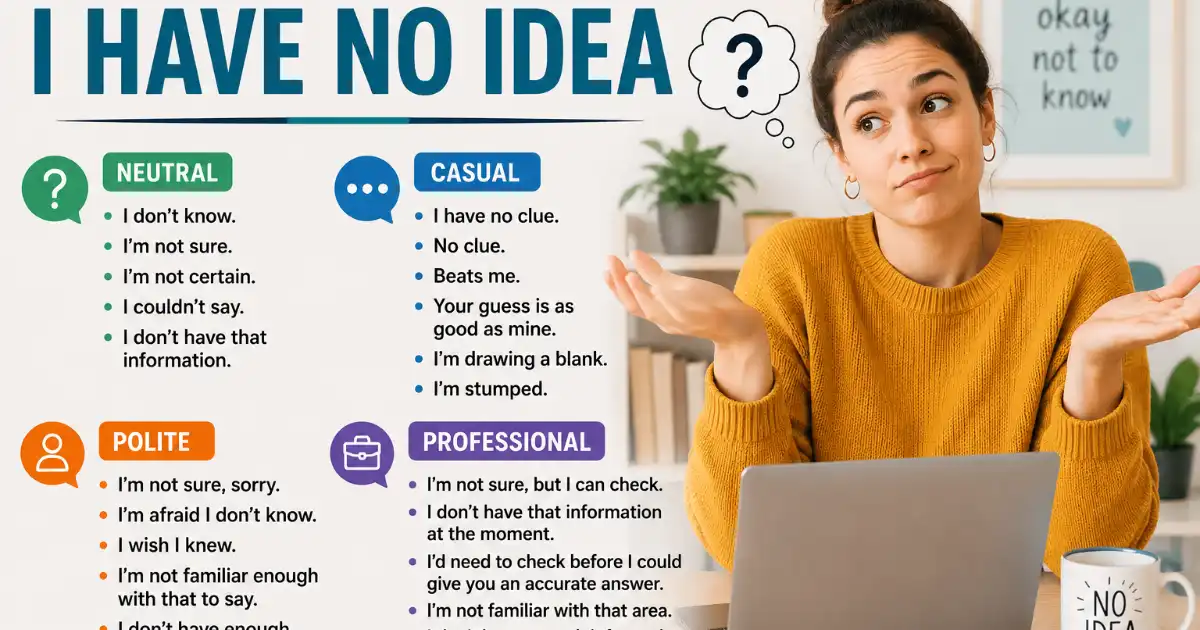
Knowing other ways to say I have no idea can help you sound more natural, polite, funny, direct, or professional. The phrase itself is common in everyday English, but it can sometimes sound blunt depending on the situation.
If you are replying to a friend, writing a work message, answering someone in a group chat, or simply want a more interesting way to admit that you do not know something, the alternatives below give you plenty of options.
Quick Answer
Other ways to say I have no idea include I’m not sure, I don’t know, I’m not certain, I couldn’t tell you, and I’m not familiar with that. For casual conversations, Beats me, Your guess is as good as mine, and I honestly have no clue can work. In professional communication, I’m not sure, but I can find out sounds more helpful and appropriate.
TL;DR
- Meaning: You do not know the answer or do not have enough information.
- Tone: It can sound neutral, casual, blunt, humorous, or polite depending on the wording.
- Common use: Everyday conversations, texting, questions, group chats, and workplace discussions.
- Where it appears: Speech, text messages, social media, email, and online conversation.
- Formal or informal: I have no idea is generally informal, while I’m not sure and I’m not certain work better in formal settings.
What I Have No Idea Means
I have no idea means I do not know the answer or I have no information about something.
It usually shows that the speaker genuinely does not know. It can also express strong uncertainty.
For example:
I have no idea where my keys are.
This means the speaker does not know where the keys are and has no useful answer.
The expression can sound perfectly normal among friends, family members, and coworkers. However, saying it in a formal situation without offering further help can sometimes sound dismissive.
Other Ways to Say I Have No Idea
There are many alternatives, and each one carries a slightly different message.
Neutral alternatives
- I don’t know.
- I’m not sure.
- I’m not certain.
- I’m unsure.
- I couldn’t say.
- I don’t have that information.
- I’m not familiar with that.
These are useful when you want to admit that you do not know without sounding overly casual.
Casual alternatives
- I have no clue.
- No clue.
- Beats me.
- Your guess is as good as mine.
- I couldn’t tell you.
- I’m drawing a blank.
- I’m stumped.
- I honestly don’t know.
These fit conversations with friends, family, and people you know well.
Polite alternatives
- I’m not sure, sorry.
- I’m afraid I don’t know.
- I’m not certain about that.
- I wish I knew.
- I’m not familiar enough with that to say.
- I don’t have enough information to answer that.
These can soften the response when someone expects an answer from you.
Professional alternatives
- I’m not sure, but I can check.
- I don’t have that information at the moment.
- I’m not certain about that.
- I’d need to check before I could give you an accurate answer.
- I’m not familiar with that area.
- I don’t have enough information to answer confidently.
These work better in professional emails, meetings, workplace chats, and other formal communication.
How People Use It in Texting or Online Conversation
In texting, people often shorten the expression because the context is already clear.
Common examples include:
- No idea.
- No clue.
- Not sure.
- IDK.
- I honestly have no clue.
- Beats me.
- Your guess is as good as mine.
IDK is an abbreviation for I don’t know. It is common in casual digital communication, although it generally does not belong in formal emails or professional documents.
A short response such as No idea can be perfectly friendly between people who already have a casual communication style. With someone you do not know well, I’m not sure can sound softer.
Tone and Emotional Meaning
The message tone depends heavily on the alternative you choose.
Neutral
I’m not sure.
This is simple and usually safe. It does not suggest frustration or humor.
Casual
Beats me.
This sounds relaxed and conversational. It usually means that you genuinely do not know.
Humorous
Your guess is as good as mine.
This adds a light, playful quality to the response.
Blunt
I don’t know.
There is nothing inherently rude about this phrase, but a very short response can sound impatient if the situation calls for more explanation.
Helpful and professional
I’m not sure, but I can check.
This is especially useful at work because you admit that you do not know while showing that you are willing to help.
Slightly frustrated
I honestly have no clue.
The word honestly can add emphasis. Depending on context, it can sound amused, frustrated, or simply sincere.
Common Situations Where These Phrases Appear
You might need an alternative when:
- A friend asks where someone went
- A coworker asks about a project detail
- Someone asks you for directions
- A family member asks about an upcoming event
- A customer asks a question you cannot answer
- Someone asks about a technical issue
- You are replying to a message online
- You want to admit uncertainty without sounding dismissive
- You want to make a casual conversation more humorous
- You need to respond professionally while checking the facts
Examples in Real Conversations
Situation: A friend asks about plans
Example:
Do you know what time they’re arriving?
I’m not sure. I’ll check.
Meaning:
You do not know yet, but you are offering to find out.
Situation: Casual texting
Example:
Who left this package at the door?
No clue.
Meaning:
A short, casual way to say you do not know.
Situation: A funny conversation
Example:
Why did he suddenly leave?
Your guess is as good as mine.
Meaning:
You genuinely do not know, but you are keeping the conversation light.
Situation: Workplace conversation
Example:
Do you know why the report was delayed?
I’m not sure, but I can check with the team.
Meaning:
You do not have the answer, but you are taking a helpful approach.
Situation: Formal communication
Example:
I’m not certain about the figures. I’d need to check the latest report.
Meaning:
You are avoiding an unsupported answer and explaining what you need to confirm it.
Situation: Someone asks about a subject you do not know
Example:
Are you familiar with that software?
I’m not familiar with it, unfortunately.
Meaning:
You are politely explaining that you lack experience with the subject.
Similar Terms or Related Phrases
Several expressions overlap with I have no idea, but they are not exactly the same.
I don’t know
This is the most direct alternative. It simply says that you do not have the answer.
I’m not sure
This can mean either that you do not know or that you have some information but lack confidence in your answer.
I have no clue
This is very similar to I have no idea but sounds more casual.
Beats me
This is informal and often has a light or slightly humorous tone.
Your guess is as good as mine
This means that you know no more than the person asking. It can sound friendly and conversational.
I’m drawing a blank
This often means you normally might know something but cannot remember it right now.
I’m not familiar with that
This suggests that you lack knowledge or experience with a particular subject.
I couldn’t say
This is a softer way to admit uncertainty. It can sound more polished than I don’t know.
When You Should Use It
I have no idea works well when you are having an ordinary conversation and want to be direct.
Use a different version if you want to communicate something more specific.
Choose I’m not sure when you have some doubt but do not want to make a definite claim.
Choose I have no clue when speaking casually.
Choose Your guess is as good as mine when you want a light, conversational tone.
Choose I’m not certain when you want something more polished.
Choose I’m not sure, but I can check when you want to be helpful, especially at work.
When You Should Avoid It
The expression is not normally rude, but context can change how it sounds.
Avoid using a very casual alternative with someone you do not know well. Beats me may sound too relaxed in a formal business email.
Also avoid giving a bare I have no idea when someone needs useful information from you in a professional setting. If you can investigate the answer, offering to check usually creates a better impression.
For important questions, it can help to explain the limit of your knowledge rather than simply saying you do not know.
For example:
I’m not certain about that, so I’d like to check the details before answering.
That response sounds more careful and responsible.
Is I Have No Idea Formal or Informal?
I have no idea is generally informal to neutral.
It works naturally in:
- Casual conversations
- Text messages
- Group chats
- Social media
- Conversations with friends
- Informal workplace discussions
It may not be the best choice for:
- Formal business letters
- Academic writing
- Official reports
- Customer-facing communication
- Situations where a careful response matters
In professional settings, I’m not sure, I’m not certain, or I don’t have that information at the moment often sounds more appropriate.
Common Misunderstandings
People sometimes assume I have no idea always sounds rude. That is not true.
Tone depends on the situation, relationship, and delivery.
A friend may say I have no idea with a smile, and the phrase sounds completely natural. In a workplace message, the same words may seem abrupt if someone expected you to investigate the issue.
Another common misunderstanding involves I’m not sure. This does not always mean complete ignorance. It can mean that you have a possible answer but do not trust it enough to state it as fact.
Similarly, I’m drawing a blank usually suggests that you cannot remember something rather than that you have never known it.
USA and Tier 1 Country Usage
I have no idea is widely understood in American, Canadian, British, Australian, and other varieties of English.
American English commonly uses casual expressions such as I have no clue, Beats me, and Your guess is as good as mine in everyday conversation. Similar expressions also appear in other English-speaking countries, although personal preferences and local conversational styles vary.
In professional communication across these regions, speakers often choose softer phrases such as I’m not sure or I’d need to check.
Texting also encourages shorter responses. No idea and IDK may appear in casual online conversation, while full sentences remain more suitable for formal communication.
Quick Reference Table
| Context | What It Means | Tone | Best Use | Avoid If |
| I don’t know | You do not know | Direct | Everyday conversation | You need a softer response |
| I’m not sure | You are uncertain | Neutral | Most situations | You know the answer clearly |
| I have no clue | You have no information | Casual | Friends and texting | Formal communication |
| Beats me | You do not know | Casual, playful | Informal conversation | Professional emails |
| Your guess is as good as mine | You know no more than the other person | Light | Friends and casual chats | Serious formal situations |
| I’m drawing a blank | You cannot remember | Casual | Memory-related questions | You have never known the answer |
| I’m not certain | You lack confidence in the answer | Polished | Professional settings | Very casual chats |
| I’m not familiar with that | You lack knowledge or experience | Polite | Work and professional settings | Simple casual questions |
| I can check | You do not know yet but can find out | Helpful | Workplace conversations | You cannot actually verify it |
Conclusion
There is nothing wrong with saying I have no idea, especially in ordinary conversation. Still, choosing a more specific alternative can help you communicate your tone more clearly.
For everyday situations, I’m not sure is a safe and natural choice. I have no clue and Beats me fit casual conversations, while I’m not certain and I’m not familiar with that work better in professional settings.
If you do not know the answer but can find it, one of the most useful responses is I’m not sure, but I can check. It is clear, polite, and shows that you are willing to help.
FAQs
What does I have no idea mean in text?
It means the person does not know the answer or has no useful information about the subject. The exact tone depends on the surrounding conversation.
What are other ways to say I have no idea in texting?
You can use No idea, No clue, I’m not sure, IDK, Beats me, or Your guess is as good as mine. Choose based on how casual the conversation is.
Is I have no idea rude?
Not usually. It is a normal English expression, but a very short response can sound blunt if the other person expects a more thoughtful answer.
Is I have no idea formal or informal?
It is generally informal to neutral. For professional communication, I’m not sure or I’m not certain may sound more polished.
What is a professional way to say I have no idea?
Try I’m not sure, I’m not certain, I don’t have that information at the moment, or I’d need to check before I could answer.
What is a funny way to say I have no idea?
Beats me and Your guess is as good as mine can add a light, humorous tone to an informal conversation.
What is the difference between I have no idea and I’m not sure?
I have no idea usually suggests that you know nothing about the answer. I’m not sure can suggest that you have some idea but lack enough confidence to be certain.
