
Introduction
Learning to write well becomes more exciting in Grade 4. Students begin writing longer stories, descriptive paragraphs, poems, and personal narratives. At this stage, simple words are not always enough to show exactly what they mean. Similes can help.
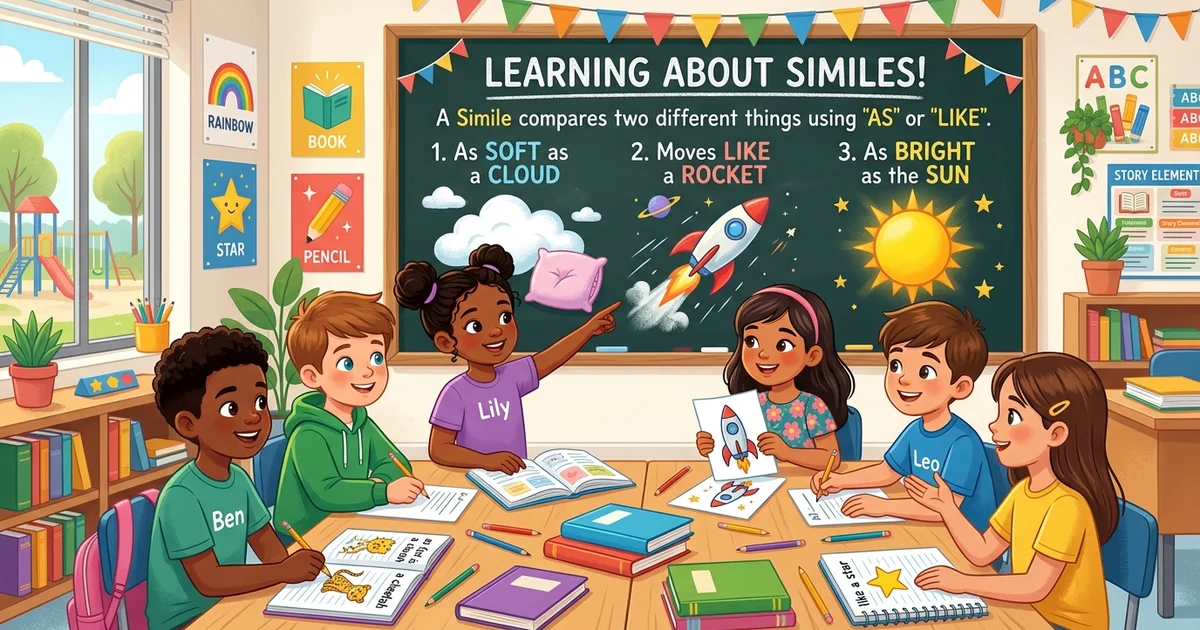
A simile compares two different things using like or as. It gives readers a clearer picture by connecting something unfamiliar to something they already know. For example, instead of writing, The puppy was very playful, a student could write, The puppy was as playful as a kitten. The comparison makes the description more colorful and easier to imagine.
Similes are also useful when reading. Students may find them in storybooks, poems, songs, and other types of writing. Once children learn how similes work, they can recognize them more easily and understand why authors use them.
This guide explains similes for Grade 4 in simple language. It includes easy examples, writing tips, creative activities, reading practice, worksheets, and a short quiz to help students understand and use similes with confidence.
Quick Answer:
A simile is a comparison between two different things that uses like or as. Writers use similes to make descriptions more vivid, interesting, and easier to imagine.
Easy examples:
- The stars twinkled like tiny diamonds.
- The pillow was as soft as a cloud.
- The runner moved like lightning.
- The lake was as smooth as glass.
- The puppy was as playful as a kitten.
Easy formula:
Thing being described + like/as + comparison
For example:
The moon glowed like a silver lantern.
The moon is being compared with a silver lantern because both can look bright and glowing.
What Is a Simile?
A simile is a figure of speech that compares two different things using like or as.
The purpose is not to say that the two things are actually the same. Instead, the writer focuses on a quality they share.
For example:
The snow was as white as a blanket.
Snow is not really a blanket. The comparison helps readers imagine how white and spread out the snow looked.
Another example is:
The boy ran like a rocket.
The boy is not a rocket. The writer compares him with a rocket because both can move very quickly.
Simile in Simple Words
You can explain a simile to a Grade 4 student like this:
A simile compares two different things using “like” or “as” to help readers make a picture in their minds.
Simile Examples for Grade 4
Here are some simple examples:
- The baby slept like a log.
- The sun was as bright as a lamp.
- The rabbit ran like the wind.
- Her smile was like sunshine.
- The water was as clear as glass.
- The clouds looked like fluffy pillows.
- The classroom was as busy as a beehive.
- The leaves floated like tiny boats.
- My backpack was as heavy as a rock.
- The kitten was as soft as cotton.
Each comparison helps the reader understand a particular quality.
Simile Examples: Simple Sentence vs. Better Description
A simile can turn an ordinary sentence into a more descriptive one.
| Simple Sentence | Sentence With a Simile |
|---|---|
| The puppy was playful. | The puppy was as playful as a kitten. |
| The river moved quickly. | The river rushed like a race car. |
| The stars were bright. | The stars glittered like tiny diamonds. |
| The pillow was soft. | The pillow was as soft as cotton. |
| The classroom was noisy. | The classroom buzzed like a busy beehive. |
| The moon was bright. | The moon shone like a silver lantern. |
The second column gives readers more information and creates stronger mental pictures.
Why Are Similes Important for Grade 4 Students?
Similes are more than just colorful phrases. They help students develop important reading and writing skills.
1. They Make Writing More Descriptive
Instead of saying:
The garden was beautiful.
A student can write:
The garden looked like a colorful painting.
The second sentence gives readers a stronger image.
2. They Encourage Creativity
Students have to think of something that shares a particular quality. This encourages them to make connections between different ideas.
3. They Improve Vocabulary
When students search for new ways to describe something, they naturally discover and use more descriptive words.
4. They Make Stories More Interesting
A story filled with clear, meaningful descriptions is usually more engaging than one made up of only simple statements.
5. They Improve Reading Comprehension
Recognizing similes helps students understand how authors describe characters, settings, emotions, and events.
Simile vs. Metaphor
Similes and metaphors both make comparisons, but they are not exactly the same.
| Simile | Metaphor |
|---|---|
| Uses like or as | Usually does not use like or as |
| The moon was like a lantern. | The moon was a lantern. |
| Her smile was like sunshine. | Her smile was sunshine. |
| The river moved like a ribbon. | The river was a ribbon. |
Easy Trick
Remember:
Simile = like or as
If a comparison uses like or as, it is often a simile.
Simile vs. Personification and Hyperbole
Grade 4 students may also encounter other types of figurative language.
| Figure of Speech | What It Does | Example |
|---|---|---|
| Simile | Compares two things using like or as | The moon shone like a lamp. |
| Metaphor | Directly compares two things | The moon was a lamp. |
| Personification | Gives human qualities to non-human things | The wind whispered. |
| Hyperbole | Uses extreme exaggeration | I have a million books. |
Knowing these differences makes figurative language easier to recognize.
How to Identify a Simile
Use these three simple steps.
Step 1: Look for “Like” or “As”
Example:
The kitten was as soft as cotton.
Step 2: Find the Two Things Being Compared
The sentence compares:
- kitten
- cotton
They are different things.
Step 3: Find the Shared Quality
Ask:
What do they have in common?
Both can be soft.
So the sentence is a simile.
Quick Check
Ask yourself:
- Are two different things being compared?
- Does the sentence use like or as?
- Is there a clear quality connecting them?
If the answer is yes, you probably found a simile.
The Parts of a Simile
Look at this example:
The puppy was as playful as a monkey.
| Part | Example |
|---|---|
| Thing being described | Puppy |
| Comparing word | As |
| Shared quality | Playful |
| Comparison | Monkey |
Understanding these parts makes it easier to create original similes.
How to Write Your Own Simile
Writing a simile becomes easy when you follow these steps.
Step 1: Choose Something to Describe
Pick a person, animal, place, object, action, or feeling.
For example:
A bicycle
Step 2: Choose Its Main Quality
Think about what you want readers to notice.
Maybe the bicycle is:
- Fast
- Shiny
- Colorful
- Light
- Strong
Let’s choose fast.
Step 3: Think of Something Else That Is Fast
You might choose:
- A rocket
- Lightning
- A cheetah
- The wind
Step 4: Connect the Ideas
Now create a simile:
My bicycle was as fast as a rocket.
Or:
My bicycle raced like the wind.
Step 5: Check Your Simile
Ask:
- Does the comparison make sense?
- Is the shared quality clear?
- Did I use like or as?
- Can the reader imagine it?
- Does it sound natural?
If yes, you have a strong simile.
A Simple Simile Formula
Use this formula when you are stuck:
Thing + like/as + something with a similar quality
Examples:
| Thing | Quality | Comparison | Simile |
|---|---|---|---|
| Puppy | Playful | Kitten | The puppy was as playful as a kitten. |
| Lake | Smooth | Glass | The lake was as smooth as glass. |
| Moon | Bright | Lantern | The moon glowed like a silver lantern. |
| Runner | Fast | Rocket | The runner moved like a rocket. |
Tips for Writing Better Similes
1. Focus on One Clear Quality
A good simile should have a clear purpose.
Instead of:
The pencil was like a spaceship.
Try:
The pencil was as sharp as a needle.
The second comparison has a clear connection.
2. Choose Familiar Comparisons
Grade 4 students should choose comparisons that readers can easily understand.
Good examples include:
- Soft as cotton
- Cold as ice
- Bright as the sun
- Light as a feather
- Smooth as glass
3. Make Your Similes Original
Common similes are useful, but creative comparisons can make writing more memorable.
Instead of:
Busy as a bee.
Try:
The kitchen was as busy as a restaurant at dinner time.
4. Make Sure the Comparison Makes Sense
A simile should connect the two things through a recognizable quality.
Weak:
The sandwich was like homework.
Better:
The sandwich was as warm as freshly baked bread.
5. Don’t Use Too Many
A simile should make writing stronger, not harder to read. A few carefully chosen comparisons are often better than putting a simile in every sentence.
50 Simile Examples for Grade 4
Here are 50 original examples students can study and use as inspiration.
- The puppy wagged its tail like a tiny fan.
- My backpack felt as heavy as a suitcase.
- The rainbow stretched like a colorful bridge.
- The leaves floated like little boats.
- The baby smiled like morning sunshine.
- The train roared like a hungry lion.
- Snowflakes drifted like soft feathers.
- My pencil moved like a speedy train.
- The lake sparkled like a field of diamonds.
- The cookies smelled like a warm bakery.
- The rabbit jumped like a bouncing ball.
- The breeze felt like a gentle whisper.
- The campfire glowed like a pile of tiny stars.
- The stars twinkled like tiny candles.
- My bicycle raced like the wind.
- The balloons floated like colorful bubbles.
- The flowers nodded like friendly neighbors.
- The tree stood as tall as a tower.
- The waves rolled like giant blue blankets.
- The moon hung like a silver lantern.
- The popcorn popped like tiny fireworks.
- My notebook opened like a treasure chest.
- The classroom buzzed like a busy beehive.
- The teacher’s smile was like bright sunshine.
- The bird soared like a paper airplane.
- The grass felt as soft as velvet.
- The thunder sounded like giant drums.
- The rain tapped like tiny fingers on the window.
- The soup was as hot as a summer sidewalk.
- The kitten curled up like a fluffy ball.
- The ice cream melted like butter in the sun.
- The old bridge stood like a silent guard.
- The butterfly floated like a colorful leaf.
- The clouds looked like giant marshmallows.
- The stream flowed like a winding ribbon.
- My little brother laughed like bubbling water.
- The horse galloped like a racing car.
- The apple was as red as a ruby.
- The squirrel climbed like an expert gymnast.
- The turtle moved as slowly as a sleepy snail.
- The football flew like a rocket.
- The stars glittered like tiny gems.
- The blanket wrapped around me like a warm hug.
- The cake was as fluffy as a cloud.
- The pencil was as straight as an arrow.
- Sunshine spread across the field like melted gold.
- The forest looked like a peaceful kingdom.
- The school bell rang like a trumpet.
- My heart beat like a fast drum before the race.
- The sunset glowed like a painting in the sky.
Animal Similes
Animals are easy subjects for Grade 4 similes because many animals have qualities children already know.
- As brave as a lion — The firefighter was as brave as a lion.
- As gentle as a deer — She was as gentle as a deer with the little kitten.
- As curious as a kitten — Liam was as curious as a kitten in the museum.
- As graceful as a swan — The dancer moved as gracefully as a swan.
- As playful as a dolphin — The children were as playful as dolphins in the water.
- As loyal as a dog — His friend was as loyal as a dog.
- As quiet as a mouse — The students became as quiet as mice.
- As busy as a bee — Mom was as busy as a bee before the party.
- As wise as an owl — The teacher seemed as wise as an owl.
- As slow as a snail — The turtle moved as slowly as a snail.
Nature Similes
Nature provides endless ideas for creative comparisons.
- The river curled like a blue ribbon.
- The stars glittered like tiny jewels.
- The leaves floated like little boats.
- The mountain stood like a giant castle.
- The waterfall sounded like a singing choir.
- The rainbow stretched like a painted bridge.
- The moon floated like a silver balloon.
- The forest looked like a sleeping giant.
- The sunset glowed like melted gold.
- The clouds drifted like fluffy ships.
Weather Similes
Weather can make a story much more vivid.
- The snow fell like white feathers.
- The rain tapped like tiny drummers.
- The wind raced like an excited child.
- The thunder rolled like giant drums.
- Lightning flashed like a camera.
- The clouds moved like giant ships.
- The fog covered the hills like a soft blanket.
- The sunshine felt like warm honey.
- The breeze brushed my face like a feather.
- Hail bounced on the ground like marbles.
School Similes
Students can use these comparisons in classroom stories and assignments.
- The classroom buzzed like a busy beehive.
- My backpack felt as heavy as a suitcase.
- The bell rang like a trumpet.
- The library was as quiet as a sleeping garden.
- My pencil moved across the page like a skater on ice.
- The hallway filled like a rushing river.
- The computer screen glowed like a bright star.
- The teacher’s voice was as gentle as a soft breeze.
- My notebook opened like a treasure chest.
- The playground sounded like a cheering crowd.
Food Similes
Food makes fun comparisons that are easy to imagine.
- The honey was as sweet as candy.
- The chips were as crunchy as autumn leaves.
- The pudding was as smooth as silk.
- The bread was as warm as sunshine.
- The popsicle was as cold as ice.
- The peach was as juicy as a summer melon.
- The whipped cream was as fluffy as a cloud.
- The fruit salad was like a colorful rainbow.
- The butter melted like snow in the sun.
- The popcorn popped like tiny fireworks.
Emotion Similes
Similes can help students describe feelings instead of simply naming them.
Happiness
- She was as happy as a child on a birthday.
- His smile shone like sunshine.
- They were as cheerful as birds in spring.
Sadness
- He felt as lonely as a single leaf.
- Her mood was like a rainy afternoon.
- The room felt as gloomy as a cloudy day.
Anger
- He was as angry as a storm.
- Her voice sounded like thunder.
- The crowd became as fierce as crashing waves.
Nervousness
- His hands felt as shaky as leaves in the wind.
- She felt like a rabbit hearing footsteps.
- He was as nervous as a bird before its first flight.
Calmness
- The lake was as peaceful as a quiet garden.
- She felt like a leaf floating on still water.
- The room was as calm as a sleeping village.
Similes in Stories
Similes can make characters, settings, and actions more vivid.
Plain Sentence
The horse ran fast.
With a Simile
The horse raced like the wind across the open field.
Plain Sentence
The old house looked scary.
With a Simile
The old house stood like a dark shadow at the end of the street.
Plain Sentence
The classroom was noisy.
With a Simile
The classroom buzzed like a busy marketplace before the lesson began.
The second versions give readers stronger mental pictures.
How Similes Improve Descriptive Writing
When students write a descriptive paragraph, they should think about the five senses:
- What does it look like?
- What does it sound like?
- What does it smell like?
- What does it feel like?
- What does it taste like?
Then they can use similes to make those details stronger.
Example: A Day at the Beach
The sand felt as soft as warm flour beneath my feet. The waves rolled toward the shore like giant blue blankets. Seagulls called like noisy trumpets above us, while the cool breeze brushed my face like a soft feather. The sun shone like a golden lamp in the clear sky.
Notice how each comparison adds a different detail.
Similes in Poetry
Poetry is a great place to find similes because poets use comparisons to create strong images and emotions.
Original Grade 4 Poem: “Morning”
The sun rose like a golden balloon,
Bright in the sky so wide.
The clouds floated like fluffy sheep,
While birds flew side by side.
The gentle breeze danced like a child,
Across the fields of green.
The flowers opened like little stars,
The prettiest I had seen.
The river shone like silver glass,
Beneath the morning light.
My heart felt as light as a feather,
And everything felt bright.
Similes in the Poem
Students can find these comparisons:
- like a golden balloon
- like fluffy sheep
- like a child
- like little stars
- like silver glass
- as light as a feather
Reading Passage: A Trip to Pine Valley Park
On Saturday morning, Maya and her family visited Pine Valley Park. The sky was as blue as a sapphire, and soft clouds floated like giant cotton ships overhead.
As they walked along the path, colorful butterflies fluttered like tiny dancing ribbons among the flowers. The fresh air smelled like blooming roses, and everyone stopped to enjoy the peaceful morning.
Soon, they reached a quiet lake. The water was as smooth as polished glass, reflecting the tall trees that stood like friendly giants around its edge. Ducks glided across the surface like little boats, leaving gentle ripples behind them.
After lunch, Maya and her brother ran toward the playground. Maya climbed the ladder like a mountain climber, while her little brother raced down the slide like a shooting star. Their laughter rang like cheerful bells across the park.
Later, dark clouds covered the sky. The wind whispered like a quiet secret, warning the family that rain was coming. Soon, raindrops tapped the ground like tiny drummers.
The family packed their picnic basket and hurried to the car. As they drove home, a beautiful rainbow stretched across the sky like a colorful bridge.
Reading Comprehension Questions
Multiple Choice
1. What was the lake compared to?
A. A mirror
B. Polished glass
C. Ice
D. A river
Answer: B. Polished glass
2. How did the butterflies move?
A. Like birds
B. Like airplanes
Answer: C. Like dancing ribbons
3. What was Maya compared to when she climbed the ladder?
A. A bird
B. A mountain climber
C. A rabbit
D. A swimmer
Answer: B. A mountain climber
4. What warned the family that rain was coming?
A. The lake
B. The butterflies
C. The wind
D. The rainbow
Answer: C. The wind
5. What was the rainbow compared to?
A. A rope
B. A road
C. A colorful bridge
D. A giant snake
Answer: C. A colorful bridge
Thinking Questions
- Which simile helped you picture the lake most clearly?
- Why do you think the writer compared the trees to friendly giants?
- Which simile is your favorite? Why?
- Write another simile to describe the playground.
- Replace one simile in the passage with your own.
Fun Simile Activities for Grade 4
1. Simile Hunt
Choose a storybook or poem and search for similes.
Create a chart:
| Simile | Things Compared | Shared Quality |
|---|---|---|
| As quiet as a mouse | Child and mouse | Quiet |
| Like a silver ribbon | River and ribbon | Shape |
| As cold as ice | Water and ice | Cold |
| Like a feather | Balloon and feather | Light |
| As bright as the sun | Light and sunshine | Brightness |
Challenge students to find five or ten similes.
2. Build Your Own Simile
Choose one word from each column.
| Quality | Comparison |
|---|---|
| Bright | Sun |
| Fast | Rocket |
| Soft | Cotton |
| Cold | Ice |
| Loud | Thunder |
| Happy | Puppy |
| Quiet | Library |
| Smooth | Glass |
| Busy | Beehive |
| Tall | Lighthouse |
Example:
The new bicycle was as fast as a rocket.
Students can create their own combinations.
3. Simile Charades
Write simple similes on cards.
Examples:
- Busy as a bee
- Slow as a snail
- Brave as a lion
- Quiet as a mouse
- Fast as lightning
- Cold as ice
- Gentle as a lamb
One student acts out the comparison while the others guess it.
4. Simile Drawing Activity
Give students a simile and ask them to draw it.
Examples:
- Bright as the sun
- Busy as a bee
- Soft as cotton
- Fast as lightning
- Like a rainbow
After drawing, students write a sentence using their simile.
5. Simile Challenge
Give students a topic such as rainy day, school, pet, or birthday party.
Ask them to write five different similes about the topic.
For example, for a rainy day:
- The rain fell like silver strings.
- Thunder sounded like giant drums.
- The clouds looked like gray mountains.
- Raindrops bounced like tiny balls.
- The wind moved like a rushing river.
Printable Simile Worksheets
Worksheet 1: Complete the Simile
Complete each sentence with a suitable comparison.
- The elephant was as big as __________.
- The pillow felt as soft as __________.
- The moon shone like __________.
- My brother ran like __________.
- The soup was as hot as __________.
- The snow looked like __________.
- The turtle moved as slowly as __________.
- The stars sparkled like __________.
- The flowers smelled as sweet as __________.
- The classroom was as busy as __________.
Sample Answers
- a bus
- a cloud
- a silver lantern
- the wind
- boiling water
- white feathers
- a snail
- tiny diamonds
- roses
- a beehive
Other answers may also be correct if the comparison makes sense.
Worksheet 2: Find the Simile
Circle the sentences that contain similes.
- The rabbit ran like the wind.
- My brother enjoys soccer.
- The stars sparkled like tiny diamonds.
- The teacher smiled warmly.
- The lake was as smooth as glass.
- My dog barked loudly.
- The baby slept like a log.
- The flowers bloomed in spring.
- The classroom buzzed like a busy market.
- The moon looked like a silver coin.
Answer Key
1, 3, 5, 7, 9, and 10
Worksheet 3: Simile or Not?
Write Yes if the sentence contains a simile and No if it does not.
| Sentence | Answer |
|---|---|
| The ice was as cold as snow. | |
| My cat likes milk. | |
| The bell rang like a trumpet. | |
| The tree was tall. | |
| The clouds floated like ships. | |
| The classroom was noisy. | |
| My backpack felt as heavy as a rock. | |
| The flowers smelled wonderful. | |
| The river curled like a ribbon. | |
| The stars twinkled brightly. |
Answer Key
Yes, No, Yes, No, Yes, No, Yes, No, Yes, No
Worksheet 4: Rewrite With a Simile
Make each sentence more descriptive by adding a simile.
Example
Plain: The dog barked loudly.
With a simile: The dog barked like a loud trumpet.
Now try:
- The girl smiled.
- The cake tasted delicious.
- The bird flew high.
- The rain fell.
- The boy ran fast.
- The classroom was quiet.
- The lake was calm.
- The flowers looked beautiful.
- The baby laughed.
- The horse galloped.
There can be many correct answers. Encourage students to make their comparisons clear and creative.
Worksheet 5: Match the Simile
Match each simile with its meaning.
| Simile | Meaning |
|---|---|
| Busy as a bee | A. Very gentle |
| Quiet as a mouse | B. Very busy |
| Strong as an ox | C. Very quiet |
| Gentle as a lamb | D. Very strong |
| Wise as an owl | E. Very wise |
Answers
- Busy as a bee → B
- Quiet as a mouse → C
- Strong as an ox → D
- Gentle as a lamb → A
- Wise as an owl → E
Creative Writing Challenge
Choose one topic and write 8–10 sentences. Try to include at least five original similes.
Topic Ideas
- A Day at the Beach
- My Dream School
- A Magical Forest
- The Best Birthday Ever
- My Favorite Animal
- A Camping Adventure
- A Day at the Zoo
- A Visit to a Science Museum
After writing, underline your similes. Then check whether every comparison makes sense.
Simile Bingo
Create Bingo cards using familiar similes such as:
- As brave as a lion
- As quiet as a mouse
- As sweet as honey
- As fast as lightning
- As cold as ice
- As soft as cotton
- As wise as an owl
- As busy as a bee
- As light as a feather
- As strong as an ox
- Like a shooting star
- Like a rainbow
- Like a whisper
- Like a feather
- Like polished glass
The teacher reads a meaning, and students find the matching simile.
Common Mistakes Students Make
Mistake 1: Forgetting “Like” or “As”
Incorrect:
The runner was lightning.
Better:
The runner moved like lightning.
Mistake 2: Making a Random Comparison
Weak:
The sandwich was like homework.
Better:
The sandwich was as warm as fresh bread.
The second comparison has a clear connection.
Mistake 3: Using Too Many Similes
A paragraph does not need a simile in every sentence. Too many comparisons can make writing feel crowded.
Use similes where they add something useful.
Mistake 4: Copying the Same Common Similes
Phrases such as busy as a bee and quiet as a mouse are correct, but students should also practice creating their own.
For example:
The kitchen was as busy as a restaurant at dinner time.
Mistake 5: Forgetting the Shared Quality
Before using a comparison, ask:
What quality do these two things share?
If you cannot explain the connection, choose a different comparison.
Advanced Writing Practice
Students who are ready for a challenge can write a 120–150-word paragraph using at least six original similes.
Choose One Topic
- My Dream Vacation
- A Snowy Day
- My Favorite Pet
- The Best Playground
- A Camping Adventure
- A Day at the Zoo
- My Favorite Holiday
After writing:
- Underline each simile.
- Circle like or as.
- Explain the shared quality.
- Remove any comparison that does not make sense.
- Check spelling and punctuation.
Teacher’s 45-Minute Lesson Plan
| Time | Activity |
|---|---|
| 5 minutes | Introduce the definition and two easy examples. |
| 10 minutes | Identify similes together. |
| 10 minutes | Complete a short worksheet. |
| 10 minutes | Students create five original similes. |
| 5 minutes | Students share their favorite examples. |
| 5 minutes | Review common mistakes. |
Learning Objectives
By the end of the lesson, students should be able to:
- Define a simile.
- Identify similes in sentences and passages.
- Explain what two things are being compared.
- Identify the shared quality.
- Write original similes using like or as.
- Use similes naturally in descriptive writing.
Simile Anchor Chart
What Is a Simile?
A simile compares two different things using like or as.
Formula
Thing + Like/As + Comparison
Examples
- As bright as the sun
- Like a silver ribbon
- As soft as cotton
- Like a butterfly
- As quiet as a library
Ask Yourself
Before calling something a simile, ask:
- Did I compare two different things?
- Did I use like or as?
- Does the comparison make sense?
- Does it create a clear picture?
If the answer is yes, you have probably created a strong simile.
Mini Test: Similes for Grade 4
1. Which sentence contains a simile?
A. The moon smiled.
B. The moon looked like a silver coin.
C. The moon was cheese.
D. The moon shone brightly.
Answer: B
2. Which words commonly introduce a simile?
A. Because and so
B. If and then
C. Like and as
D. Before and after
Answer: C
3. Which sentence is a metaphor?
A. The river flowed like a ribbon.
B. The river was a ribbon.
C. The river was clear.
D. The river moved quickly.
Answer: B
4. Which sentence contains personification?
A. The tree was tall.
B. The wind whispered through the forest.
C. The tree was like a giant.
D. The wind was cold.
Answer: B
5. Which is the strongest simile?
A. The apple was homework.
B. The apple was as red as a ruby.
C. The apple jumped.
D. The apple is a ruby.
Answer: B
Parent’s Guide to Practicing Similes at Home
Parents do not need complicated materials to help children practice similes.
Try these simple activities:
- Read a story together and look for similes.
- Ask your child to describe an everyday object with a comparison.
- Keep a small simile journal.
- Play “Finish the Simile.”
- Describe the weather using one simile.
- Compare foods, toys, animals, or places.
- Ask your child to explain why a comparison works.
The goal is to make practice enjoyable rather than turning it into memorization.
Why Similes Make Writing Better
Compare these two sentences:
The flower was pretty.
and:
The flower opened like a colorful umbrella in the sunshine.
The second sentence gives readers a stronger mental picture.
Similes can make writing:
- More descriptive
- More creative
- More memorable
- Easier to visualize
- More enjoyable to read
They also encourage students to think carefully about words and the connections between different things.
Key Takeaways
Remember these important points about similes:
- A simile compares two different things.
- It commonly uses like or as.
- A good simile has a clear shared quality.
- Similes help readers create mental pictures.
- Original comparisons can make writing more interesting.
- Similes can describe people, animals, objects, places, actions, and feelings.
- Students can find similes in stories, poems, songs, and everyday language.
- The best similes are clear, meaningful, and natural.
Conclusion
Learning similes for Grade 4 can make writing more creative while helping students become stronger readers and communicators. A simple comparison using like or as can turn an ordinary sentence into a description that readers can easily picture.
Students can start with familiar comparisons such as as soft as cotton or like a silver lantern, then gradually create their own original ideas. The most important thing is to make sure the comparison has a clear connection and helps the reader understand something better.
The best way to learn is through practice. Read similes in stories, search for them in poems, complete worksheets, play classroom games, and write original comparisons in stories and paragraphs. With regular practice, students can use similes naturally and confidently.
Frequently Asked Questions
What is a simile for Grade 4?
A simile is a comparison between two different things that uses like or as. It helps students make their writing more descriptive and easier to imagine.
What are five easy similes?
Five simple examples are:
- As busy as a bee
- As quiet as a mouse
- As soft as cotton
- As bright as the sun
- As sweet as honey
How do I explain a simile to a fourth grader?
Tell the student that a simile compares two different things using like or as to help readers imagine a quality more clearly.
How can Grade 4 students identify a simile?
First, look for like or as. Then check whether two different things are being compared and whether they share a clear quality.
What is the difference between a simile and a metaphor?
A simile usually uses like or as, while a metaphor makes a direct comparison.
Simile: Her smile was like sunshine.
Metaphor: Her smile was sunshine.
Why do authors use similes?
Authors use similes to create vivid images, express feelings, describe characters and settings, and make writing more interesting.
Can students create their own similes?
Yes. In fact, creating original similes is an excellent way for students to develop creativity and descriptive writing skills.
Where can students find similes?
Similes can appear in:
- Stories
- Poems
- Novels
- Songs
- Speeches
- Fairy tales
- Classroom writing
- Everyday conversations
How many similes should a student use?
There is no fixed number. Students should use similes naturally where they improve the description. A few strong comparisons are usually better than adding one to every sentence.
Can a simile compare feelings?
Yes. Similes are especially useful for describing emotions.
For example:
She felt as nervous as a bird before its first flight.
This gives readers a clearer idea of how nervous she felt.
