
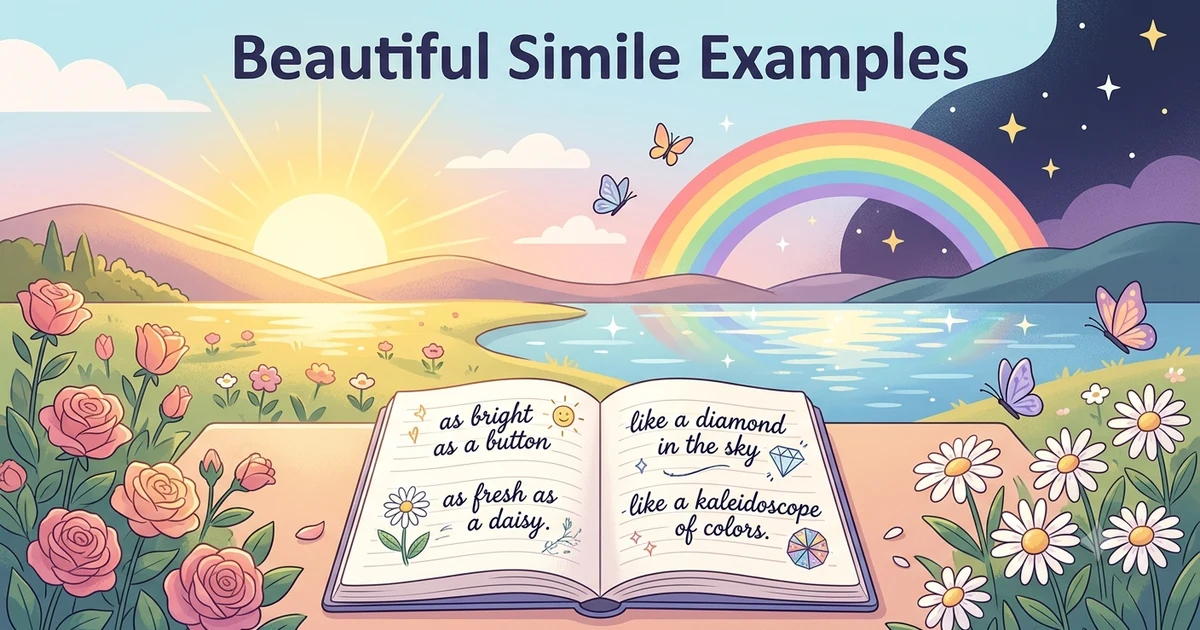
Beautiful Simile Examples That Make Your Writing Shine
Introduction
Beauty is everywhere. It appears in a glowing sunset, a kind smile, a peaceful forest, a heartfelt moment, or even a simple act of kindness. Yet describing beauty with the same word over and over can make your writing feel repetitive. Readers want descriptions that help them picture a scene, feel an emotion, and remember what they have read.
That is where similes become powerful. A well-written simile compares beauty to something familiar, allowing readers to create a vivid mental image. Instead of saying someone is beautiful, you can compare them to the first light of dawn, a blooming cherry tree, or stars reflected on a quiet lake. These comparisons make ordinary descriptions feel fresh, emotional, and memorable.
Whether you are writing a school essay, a poem, a novel, a speech, a greeting card, or a social media caption, beautiful similes can make your words more expressive. They add color, emotion, and creativity without making your writing difficult to understand.
This guide includes more than 50 beautiful simile examples, practical writing tips, categorized comparisons, common mistakes to avoid, and real-life examples that will help you use similes naturally and confidently.
Quick Answer
A beautiful simile is a comparison that uses the words “like” or “as” to describe beauty in a vivid and imaginative way. Instead of simply saying something is beautiful, a simile compares it to another object, person, or scene that shares the same quality. For example, “Her smile was as beautiful as the first sunrise of spring” or “The lake shimmered like polished crystal beneath the morning sun.” Beautiful similes help readers picture what you are describing, create stronger emotions, and make your writing more memorable. They are commonly used in poetry, stories, speeches, essays, and everyday conversations.
What Is a Simile?
A simile is a figure of speech that compares two different things using the words “like” or “as.” The purpose of a simile is to make descriptions more interesting and easier to imagine.
Rather than giving a plain description, a simile creates a picture in the reader’s mind by connecting one thing with another that shares a similar quality.
Simple Examples
- Her face was as bright as the morning sun.
- His voice was like gentle rain on a quiet afternoon.
- The flowers looked as colorful as a painter’s palette.
- The river sparkled like thousands of tiny diamonds.
These comparisons help readers experience the scene instead of simply reading about it.
Simile vs. Metaphor
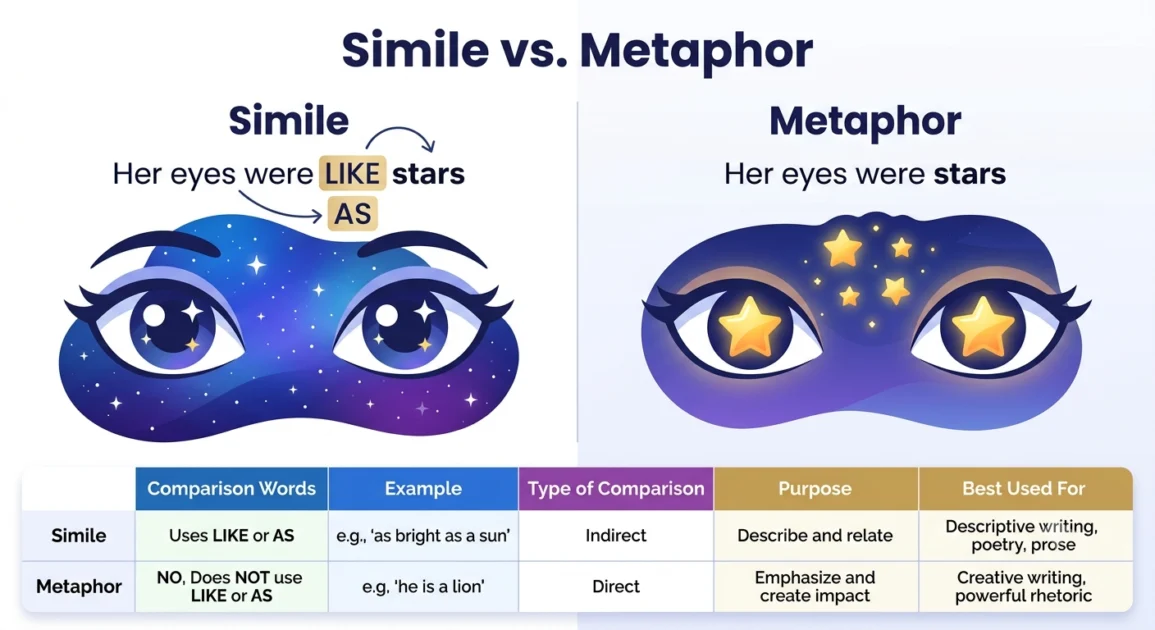
Although similes and metaphors both compare two things, they do so in different ways.
| Feature | Simile | Metaphor |
|---|---|---|
| Comparison Words | Uses “like” or “as” | Does not use “like” or “as” |
| Example | Her eyes were like stars. | Her eyes were stars. |
| Style | Direct comparison | Implied comparison |
| Best For | Clear descriptions | Strong poetic effect |
If you are just beginning to learn figurative language, similes are usually easier to understand because the comparison is clearly stated.
Why Use Similes for Beautiful?
The word beautiful is meaningful, but using it repeatedly can make writing sound ordinary. Similes replace simple descriptions with vivid images that readers can easily imagine.
Beautiful similes can help you:
- Paint clear mental pictures.
- Create stronger emotional connections.
- Make stories and poems more memorable.
- Add creativity without using complicated words.
- Improve descriptive writing for school or professional work.
- Capture feelings that ordinary adjectives cannot fully express.
Compare these two sentences:
Plain: The garden was beautiful.
Better: The garden was as beautiful as spring painted across the earth.
The second sentence allows readers to picture the scene instead of simply being told that it was beautiful.
When Should You Use Beautiful Similes?
Beautiful similes fit naturally into many types of writing.
Stories
Describe characters, settings, and emotional moments with greater detail.
Example:
The old castle stood as beautiful as a forgotten dream beneath the evening sky.
Poetry
Poets use similes to create rhythm, emotion, and memorable imagery.
Example:
Her laughter danced like sunlight across gentle waves.
Essays
Descriptive essays become more engaging when similes help readers visualize ideas.
Example:
The valley stretched before us like a green blanket woven by nature.
Speeches
A thoughtful simile can make an important message easier to remember.
Example:
Hope is like the first ray of sunshine after a long winter.
Social Media Captions
Creative comparisons make captions more eye-catching.
Example:
Smiling like sunshine after the rain.
What Makes a Beautiful Simile?
Not every comparison creates a strong image. The best similes share a few important qualities.
They Are Easy to Picture
Readers should immediately understand the comparison.
✅ Her smile was as warm as morning sunlight.
They Feel Natural
A good simile should fit the situation without sounding forced.
✅ The lake shimmered like polished glass.
They Create Emotion
Strong similes help readers feel happiness, peace, excitement, or wonder.
✅ His kindness spread like the first warmth of spring.
They Are Original
Fresh comparisons make writing stand out more than overused expressions.
Instead of:
❌ Beautiful as a rose.
Try:
✅ Beautiful as moonlight resting on quiet water.
Top 15 Beautiful Similes with Meanings
| Simile | Meaning | Best Used For |
|---|---|---|
| As beautiful as the first sunrise of spring | Fresh, hopeful beauty | People, nature |
| Like moonlight resting on still water | Calm and peaceful beauty | Landscapes |
| As beautiful as cherry blossoms in bloom | Delicate beauty | Flowers, people |
| Like golden light through autumn leaves | Warm and comforting beauty | Nature |
| As beautiful as stars reflected on a quiet lake | Peaceful and magical | Romantic writing |
| Like fresh snow sparkling at dawn | Pure and graceful | Winter scenes |
| As beautiful as a rainbow after summer rain | Joyful and colorful | Happiness |
| Like a masterpiece painted by nature | Perfect natural beauty | Landscapes |
| As beautiful as a field of wildflowers | Bright and lively | Gardens |
| Like crystal catching the morning sun | Brilliant and clear | Objects |
| As beautiful as gentle waves at sunset | Calm and relaxing | Beaches |
| Like soft petals floating in the breeze | Elegant movement | People |
| As beautiful as the northern sky filled with stars | Grand and breathtaking | Night scenes |
| Like sunlight dancing across the ocean | Bright and energetic | Water scenes |
| As beautiful as the first bloom after winter | Hopeful new beginnings | Inspirational writing |
Why Original Similes Are Better
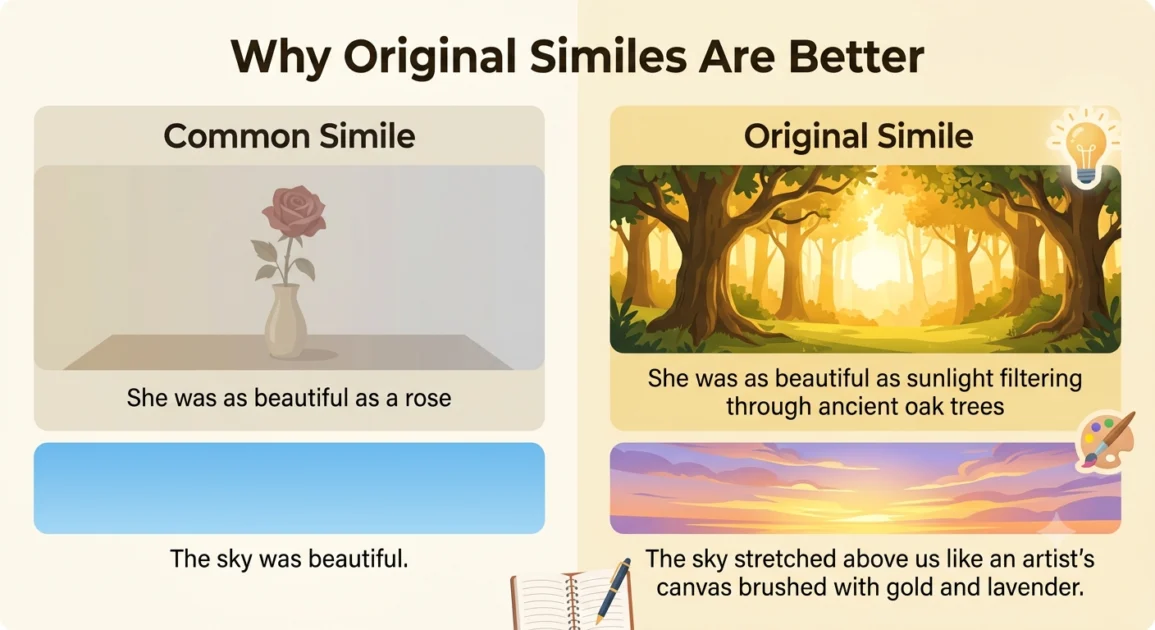
Many writers use comparisons like “beautiful as a rose” because they are familiar. While these classics still work, they no longer surprise readers.
Original similes make your writing feel fresh.
Compare these examples:
Common:
She was as beautiful as a rose.
More Original:
She was as beautiful as sunlight filtering through ancient oak trees.
Common:
The sky was beautiful.
More Original:
The sky stretched above us like an artist’s canvas brushed with gold and lavender.
Fresh imagery helps readers remember your writing long after they finish reading.
Beautiful Simile Examples That Make Your Writing Shine
In this section, you will find more than 50 original similes for beautiful, grouped into useful categories. Each simile includes its meaning and an example sentence so you can easily use it in your own writing.
Beautiful Similes for People
| Simile | Meaning | Example Sentence |
|---|---|---|
| As beautiful as the first light of dawn | Fresh, hopeful, and radiant | She looked as beautiful as the first light of dawn. |
| Like a flower opening to the morning sun | Graceful and full of life | The young dancer moved like a flower opening to the morning sun. |
| As beautiful as a calm spring morning | Peaceful and refreshing | His daughter looked as beautiful as a calm spring morning. |
| Like sunshine after days of rain | Cheerful and comforting | Her smile felt like sunshine after days of rain. |
| As beautiful as a field of blooming wildflowers | Colorful and lively | The children looked as beautiful as a field of blooming wildflowers. |
| Like golden rays touching mountain peaks | Bright and inspiring | She stood like golden rays touching mountain peaks. |
| As beautiful as a dream remembered forever | Deeply memorable | Their wedding was as beautiful as a dream remembered forever. |
| Like morning dew resting on petals | Pure and delicate | The baby looked like morning dew resting on petals. |
Beautiful Similes for a Smile
A genuine smile can brighten an entire room. These similes help describe smiles in a fresh and memorable way.
| Simile | Meaning | Example Sentence |
|---|---|---|
| As beautiful as sunrise over the ocean | Bright and uplifting | Her smile was as beautiful as sunrise over the ocean. |
| Like sunlight shining through the clouds | Hopeful and warm | His smile spread like sunlight shining through the clouds. |
| As beautiful as spring after winter | Full of hope | Her smile was as beautiful as spring after winter. |
| Like stars appearing at twilight | Gentle and magical | The little girl’s smile appeared like stars at twilight. |
| As beautiful as laughter carried by the wind | Joyful and natural | His smile was as beautiful as laughter carried by the wind. |
| Like the glow of a candle in darkness | Comforting | Her smile felt like the glow of a candle in darkness. |
| As beautiful as fresh blossoms in April | Bright and youthful | Her smile was as beautiful as fresh blossoms in April. |
| Like a rainbow after heavy rain | Full of happiness | His smile appeared like a rainbow after heavy rain. |
Beautiful Similes for Eyes
Eyes often reveal emotions better than words. These comparisons help paint a vivid picture.
| Simile | Meaning | Example Sentence |
|---|---|---|
| As beautiful as stars reflected on a quiet lake | Peaceful and sparkling | Her eyes were as beautiful as stars reflected on a quiet lake. |
| Like crystal catching the morning sun | Bright and clear | His eyes shone like crystal catching the morning sun. |
| As beautiful as the deep blue sea | Calm and mysterious | Her eyes were as beautiful as the deep blue sea. |
| Like moonlight on still water | Soft and gentle | Her eyes glowed like moonlight on still water. |
| As beautiful as autumn skies | Rich and colorful | His eyes were as beautiful as autumn skies. |
| Like tiny galaxies filled with light | Full of wonder | Her eyes looked like tiny galaxies filled with light. |
| As beautiful as polished emeralds | Rich and elegant | Her green eyes were as beautiful as polished emeralds. |
| Like stars hidden behind soft clouds | Quiet beauty | His eyes sparkled like stars hidden behind soft clouds. |
Beautiful Similes for Nature
Nature offers endless inspiration for beautiful comparisons.
| Simile | Meaning | Example Sentence |
|---|---|---|
| As beautiful as cherry blossoms in spring | Delicate and colorful | The park looked as beautiful as cherry blossoms in spring. |
| Like sunlight dancing across a river | Bright and lively | The water sparkled like sunlight dancing across a river. |
| As beautiful as mountains wearing snow | Majestic | The landscape was as beautiful as mountains wearing snow. |
| Like butterflies floating through flowers | Peaceful movement | The garden looked like butterflies floating through flowers. |
| As beautiful as a valley covered with wildflowers | Rich and vibrant | The countryside was as beautiful as a valley covered with wildflowers. |
| Like soft rain falling on green fields | Calm and refreshing | The scene felt like soft rain falling on green fields. |
| As beautiful as leaves glowing in autumn | Warm and colorful | The forest became as beautiful as leaves glowing in autumn. |
| Like waves kissing the sandy shore | Gentle and relaxing | The beach looked like waves kissing the sandy shore. |
Beautiful Similes for the Sky
The sky constantly changes, making it one of the best sources of inspiration.
| Simile | Meaning | Example Sentence |
|---|---|---|
| As beautiful as a sky painted with sunset colors | Rich and breathtaking | The evening sky was as beautiful as a sky painted with sunset colors. |
| Like cotton clouds floating peacefully | Soft and calm | The afternoon sky looked like cotton clouds floating peacefully. |
| As beautiful as stars scattered across velvet | Magical night sky | The heavens were as beautiful as stars scattered across velvet. |
| Like the colors of a watercolor painting | Artistic beauty | The sunset spread like the colors of a watercolor painting. |
| As beautiful as the northern lights | Extraordinary | The sky became as beautiful as the northern lights. |
| Like gold melting into blue | Warm sunset | Evening arrived like gold melting into blue. |
Beautiful Similes for Love
Love is easier to express through meaningful comparisons.
| Simile | Meaning | Example Sentence |
|---|---|---|
| As beautiful as two hearts beating together | Deep connection | Their love was as beautiful as two hearts beating together. |
| Like roses blooming after gentle rain | Growing stronger | Their relationship grew like roses blooming after gentle rain. |
| As beautiful as the first page of a favorite story | Full of promise | Their future seemed as beautiful as the first page of a favorite story. |
| Like stars guiding travelers home | Safe and comforting | Her love felt like stars guiding travelers home. |
| As beautiful as music filling a quiet room | Peaceful happiness | Their friendship was as beautiful as music filling a quiet room. |
| Like a warm fire on a winter night | Comfort and security | His love felt like a warm fire on a winter night. |
Beautiful Similes for Flowers
Flowers symbolize beauty in countless ways, but these comparisons go beyond the usual clichés.
| Simile | Meaning | Example Sentence |
|---|---|---|
| As beautiful as a lily opening at sunrise | Elegant and pure | The bride looked as beautiful as a lily opening at sunrise. |
| Like lavender blooming across rolling hills | Peaceful beauty | The garden stretched like lavender blooming across rolling hills. |
| As beautiful as a rose covered in morning dew | Fresh and delicate | The bouquet was as beautiful as a rose covered in morning dew. |
| Like sunflowers reaching toward the sky | Bright and optimistic | The children stood like sunflowers reaching toward the sky. |
| As beautiful as orchids blooming in silence | Rare and graceful | Her artwork was as beautiful as orchids blooming in silence. |
| Like petals carried on a gentle breeze | Soft movement | The dancer moved like petals carried on a gentle breeze. |
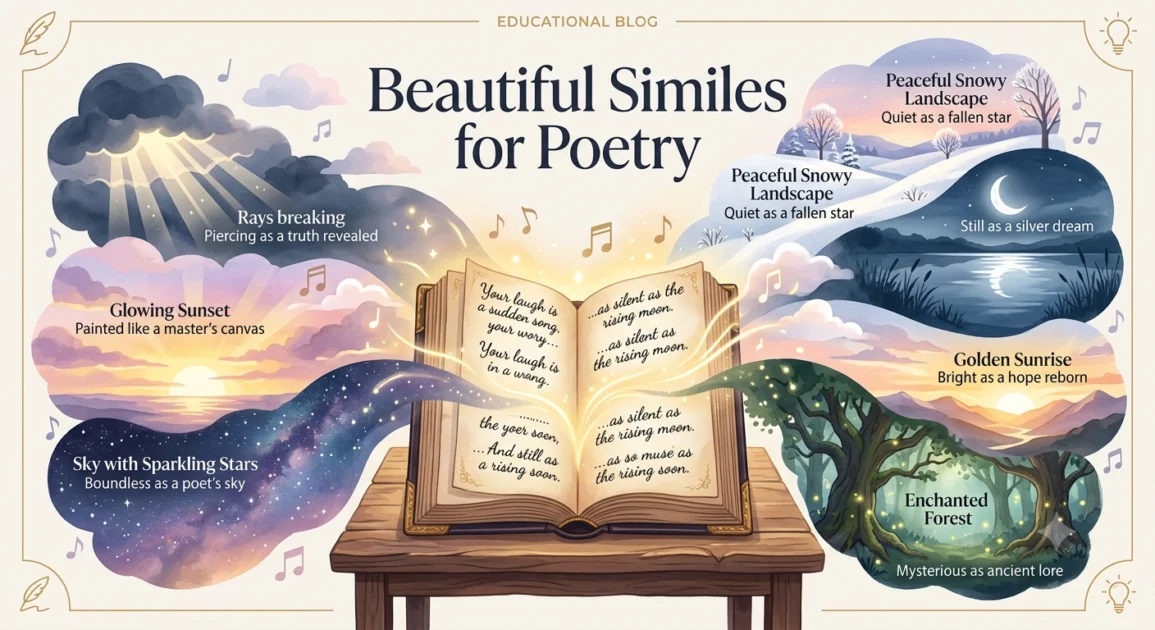
Beautiful Similes for Poetry
These comparisons are especially effective in poems, speeches, and creative writing.
- As beautiful as silence after snowfall.
- Like moonlight woven into silver threads.
- As beautiful as hope rising with the dawn.
- Like whispers carried through ancient forests.
- As beautiful as stars singing without sound.
- Like a melody floating across still waters.
- As beautiful as time standing still at sunset.
- Like dreams painted across the evening sky.
- As beautiful as the calm before sunrise.
- Like light finding its way through darkness.
These poetic similes create emotional imagery without sounding overly complicated.
Beautiful Similes for Everyday Writing
You do not have to write poetry to use similes. They can improve everyday communication as well.
School Essay
The museum was as beautiful as a page from a history book brought to life.
Story
The castle stood like a silent guardian watching over the valley.
Greeting Card
Your kindness is as beautiful as the first flowers of spring.
Social Media Caption
Shining like the morning sun.
Speech
True friendship is as beautiful as a tree that grows stronger with every passing season.
These examples show that similes can make almost any type of writing more engaging.
Beautiful Simile Examples That Make Your Writing Shine
How to Create Your Own Beautiful Similes
Writing your own similes is easier than it seems. The best comparisons come from observing the world around you instead of relying on overused expressions. A fresh simile helps readers see beauty from a new perspective and makes your writing more memorable.
Follow these simple steps.
1. Decide What You Want to Describe
Think about the person, place, object, or feeling you want readers to imagine.
Examples:
- A smile
- A sunset
- A flower
- A snowy mountain
- A kind person
2. Identify the Main Quality
Ask yourself what makes it beautiful.
Is it:
- Bright?
- Peaceful?
- Colorful?
- Gentle?
- Elegant?
- Pure?
- Inspiring?
Knowing the strongest quality makes choosing the right comparison much easier.
3. Find Something That Shares the Same Quality
Look for inspiration in nature, everyday life, music, seasons, weather, or memorable experiences.
For example:
Bright → Morning sunshine
Peaceful → A quiet lake
Colorful → A rainbow after rain
Gentle → Falling snow
Elegant → A swan gliding across water
4. Connect Them with “Like” or “As”
Now turn your idea into a complete simile.
Simple sentence:
The waterfall was beautiful.
Better sentence:
The waterfall was as beautiful as silver ribbons flowing down the mountainside.
Another example:
Simple:
She looked beautiful.
Better:
She looked as beautiful as moonlight shining across a quiet ocean.
Beautiful vs. Pretty vs. Gorgeous
Although these words are similar, they are not exactly the same.
| Word | Meaning | Example |
|---|---|---|
| Beautiful | Deep, timeless beauty | The old cathedral was beautiful. |
| Pretty | Pleasant and attractive | She wore a pretty blue dress. |
| Gorgeous | Extremely striking beauty | The sunset looked gorgeous over the beach. |
Understanding these differences helps you choose the right word before creating a simile.
For example:
Pretty
She was as pretty as a spring blossom.
Beautiful
She was as beautiful as the first sunrise of spring.
Gorgeous
She looked like the evening sky painted with gold and crimson.
Common Mistakes to Avoid
Even good writers sometimes create weak similes. Avoid these common mistakes to make your comparisons more natural and effective.
1. Using Too Many Clichés
Overused comparisons have lost much of their impact.
❌ She was as beautiful as a rose.
✅ She was as beautiful as sunlight filtering through autumn leaves.
2. Comparing Unrelated Things
Your comparison should make logical sense.
❌ Beautiful like a calculator.
✅ Beautiful like a quiet garden after rain.
3. Making Similes Too Long
Long comparisons can confuse readers.
❌ The sunset was like an enormous collection of colorful lights shining through every cloud in every direction across the entire horizon.
✅ The sunset was like a painter’s final brushstroke across the sky.
4. Repeating the Same Simile
Using the same comparison again and again makes writing repetitive.
Instead of repeating:
- Beautiful as a rose
- Beautiful as a rose
- Beautiful as a rose
Try different comparisons.
- Beautiful as fresh snowfall.
- Beautiful as morning light.
- Beautiful as stars above the sea.
- Beautiful as blooming lavender.
5. Forgetting Your Audience
Choose comparisons your readers can easily understand.
For young students:
The butterfly was as beautiful as a rainbow.
For poetry:
The butterfly drifted like a painted dream carried by the wind.
Tips for Writing Better Similes
Professional writers often use these techniques.
Observe Nature
Nature provides endless inspiration.
Notice:
- Clouds
- Rivers
- Birds
- Mountains
- Flowers
- Sunsets
- Snow
- Rain
Use Your Five Senses
Great similes appeal to more than sight.
Think about:
- Sound
- Smell
- Touch
- Taste
- Sight
Example:
Her voice was as beautiful as soft music drifting through an open window.
Keep It Simple
Readers remember clear comparisons more easily than complicated ones.
Be Original
Instead of copying familiar expressions, create fresh images from your own observations.
Read More
Books, poems, and quality articles can inspire new ways to compare beauty.
Practice Exercises
Try these activities to improve your descriptive writing.
Exercise 1
Complete each simile.
- The garden was as beautiful as __________.
- Her eyes sparkled like __________.
- The lake looked as beautiful as __________.
- The sunset spread like __________.
Exercise 2
Rewrite these simple sentences using similes.
Simple:
The beach was beautiful.
Possible answer:
The beach was as beautiful as a postcard brought to life.
Simple:
The child smiled.
Possible answer:
The child smiled like sunshine breaking through clouds.
Exercise 3
Create Your Own Similes
Write one simile for each topic.
- A flower
- A mountain
- A river
- A friend
- A smile
Practice regularly, and creating original similes will become easier over time.
Why Beautiful Similes Improve Writing
Beautiful similes do more than decorate sentences. They help readers connect with your ideas by creating clear mental pictures and emotional depth.
Whether you are writing fiction, poetry, essays, speeches, or social media captions, the right comparison makes ordinary descriptions more engaging. Instead of simply telling readers that something is beautiful, you allow them to imagine and experience that beauty for themselves.
Fresh, meaningful similes also make your writing stand out. Rather than relying on familiar expressions, thoughtful comparisons add originality and leave a lasting impression.
Conclusion
Beauty is easier to appreciate than to describe, but similes make that task much simpler. By comparing beauty with familiar images from nature, everyday life, and personal experiences, you can turn ordinary sentences into vivid descriptions that readers remember.
Whether you are describing a person, a landscape, a smile, or a special moment, the right simile adds emotion, clarity, and creativity. Instead of repeating the word beautiful, use fresh comparisons that paint a picture in the reader’s mind.
The best similes are simple, meaningful, and original. Keep observing the world around you, experiment with new comparisons, and practice regularly. Over time, your writing will become more expressive, engaging, and memorable.
Frequently Asked Questions
What is a beautiful simile?
A beautiful simile is a comparison that uses “like” or “as” to describe beauty in a vivid and imaginative way. It helps readers visualize people, places, objects, or feelings more clearly.
What are some examples of beautiful similes?
Some creative examples include:
- As beautiful as the first sunrise of spring.
- Like moonlight resting on still water.
- As beautiful as stars reflected on a quiet lake.
- Like golden light through autumn leaves.
- As beautiful as fresh snow sparkling at dawn.
Why are similes important in writing?
Similes make descriptions more expressive, create vivid imagery, strengthen emotional impact, and help readers remember what they read.
What is the difference between a simile and a metaphor?
A simile compares two things using “like” or “as,” while a metaphor makes a direct comparison without those words.
Can I use similes in school essays?
Yes. Appropriate similes can make descriptive essays, stories, speeches, and creative writing more interesting without making them difficult to read.
How can I write original similes?
Observe nature, think about the quality you want to describe, choose a meaningful comparison, and avoid relying on overused expressions.
