

Introduction
Excitement can be one of the easiest emotions to feel but one of the harder ones to describe. When something wonderful is about to happen, you might smile without realizing it, talk faster, move around more than usual, or feel your heart beating harder. Sometimes excitement feels warm and joyful. Other times it comes with nervousness, especially when you are waiting for important news or preparing for a big moment.
Simply writing “I was excited” tells the reader what happened, but it does not give them much to imagine. This is where similes for feeling excited can make your writing more interesting. A good simile compares excitement with something readers already know, such as fireworks, a rocket, a bouncing spring, popcorn, or a puppy waiting for its owner.
For example, saying “She was as excited as a child on Christmas morning” immediately creates an image of happiness and anticipation. Saying “His heart raced like a drum before a big performance” shows a different kind of excitement, one mixed with nervous energy.
You can use these comparisons in stories, poems, school essays, speeches, journal entries, social media captions, and everyday conversations. Some are simple and kid-friendly, while others are more creative or poetic.
In this guide, you will find easy, funny, creative, powerful, poetic, and nervous-excitement similes, along with examples that show how to use them naturally.
Quick Answer
Similes for feeling excited compare excitement to familiar things that show energy, happiness, anticipation, or nervousness. Examples include “as excited as a child on Christmas morning,” “like a rocket ready to blast off,” “as jumpy as popcorn in a hot pan,” and “like fireworks bursting in the sky.” These comparisons make writing more vivid because they help readers picture what excitement looks and feels like instead of simply being told that someone is excited.
What Is an Excited Simile?
An excited simile is a comparison used to describe the feeling of excitement. It normally uses “like” or “as” to connect the emotion with something familiar.

For example:
- She was as excited as a child on Christmas morning.
- He jumped like a puppy seeing its owner.
- My heart raced like a drum before a big performance.
- I felt like fireworks were bursting inside me.
The comparison gives the reader a picture instead of simply naming the emotion.
A strong excited simile should match the type of excitement you want to show. Someone waiting for a concert may feel energetic and eager. A student waiting for exam results may feel excited but nervous. Someone receiving an unexpected gift may feel surprised and joyful.
Choosing the right comparison makes the sentence feel more natural.
What Does Feeling Excited Mean?
Feeling excited means having a strong sense of enthusiasm, anticipation, or happiness about something that is happening or about to happen.
Excitement can affect both your thoughts and your body. You may feel energetic, find it difficult to sit still, smile more, speak quickly, or notice your heart beating faster.
The feeling can be positive and playful, such as when you are about to go on vacation. It can also be mixed with nervousness, such as before a job interview, performance, competition, or important announcement.
This is why different similes work for different situations.
For example:
Happy excitement:
She was as cheerful as a child opening a birthday gift.
Restless excitement:
He was as jumpy as popcorn in a hot pan.
Nervous excitement:
Her stomach felt like butterflies were fluttering inside it.
Extreme excitement:
His happiness burst like fireworks across the night sky.
Best Similes for Feeling Excited
As Excited as a Child on Christmas Morning
Meaning: Extremely happy and eager about something special.
Example: She was as excited as a child on Christmas morning when she opened the package.
This comparison works well for birthdays, gifts, vacations, concerts, holidays, and other events people look forward to.
Like a Rocket Ready to Blast Off
Meaning: Full of energy and ready for something exciting to happen.
Example: He felt like a rocket ready to blast off before the race.
It works especially well when someone cannot sit still.
As Jumpy as Popcorn in a Hot Pan
Meaning: Restless and full of nervous energy.
Example: The students were as jumpy as popcorn in a hot pan while waiting for the results.
This is a fun choice for children, casual stories, and humorous writing.
As Bouncy as a Spring
Meaning: Full of light, cheerful energy.
Example: She was as bouncy as a spring after hearing the good news.
This simile works well when excitement makes someone move around happily.
Like Fireworks Bursting in the Sky
Meaning: A sudden and powerful feeling of happiness or excitement.
Example: Her excitement felt like fireworks bursting in the sky.
This is especially useful in creative and emotional writing.
As Buzzing as a Beehive
Meaning: Full of activity, energy, and excitement.
Example: The classroom was as buzzing as a beehive after the teacher announced the field trip.
This comparison can describe a person, group, room, classroom, office, or crowd.
Like a Puppy Seeing Its Owner
Meaning: Showing innocent, playful, and energetic excitement.
Example: He ran toward his friends like a puppy seeing its owner.
This is a warm and playful comparison that works well for kids and casual writing.
As Electric as a Thunderstorm
Meaning: Filled with powerful energy and anticipation.
Example: The stadium felt as electric as a thunderstorm before the championship game.
This is a stronger option for dramatic moments.
Similes for Excitement and Anticipation
Excitement often comes from waiting for something to happen. This feeling is called anticipation.

These similes work well when someone is counting down to an important moment:
- Like a rocket waiting for its countdown
- As eager as a runner waiting for the starting signal
- Like a child waiting for a birthday
- As restless as someone waiting for important news
- Like a fan waiting for the concert doors to open
- As ready as a player before the final whistle
- Like a spring being pushed down and ready to bounce
Example: She was like a rocket waiting for its countdown before the announcement.
These comparisons make the waiting itself feel exciting.
Similes That Describe Physical Signs of Excitement
Excitement is not only an emotion. It can also show through physical reactions.
You may notice:
- A racing heart
- A wide smile
- Restless hands
- Fast talking
- Jumping or bouncing
- Bright eyes
- A fluttering stomach
- Quick movements
You can turn these reactions into similes.
Racing heart:
His heart raced like a drum before a performance.
Wide smile:
Her smile spread like sunshine across her face.
Restless movement:
He moved like a spring that had just been released.
Bright eyes:
Her eyes shone like stars on a clear night.
Fluttering stomach:
My stomach felt like butterflies were flying around inside it.
These descriptions help readers experience the excitement through physical details.
Positive Excitement vs Nervous Excitement
Not all excitement feels the same.
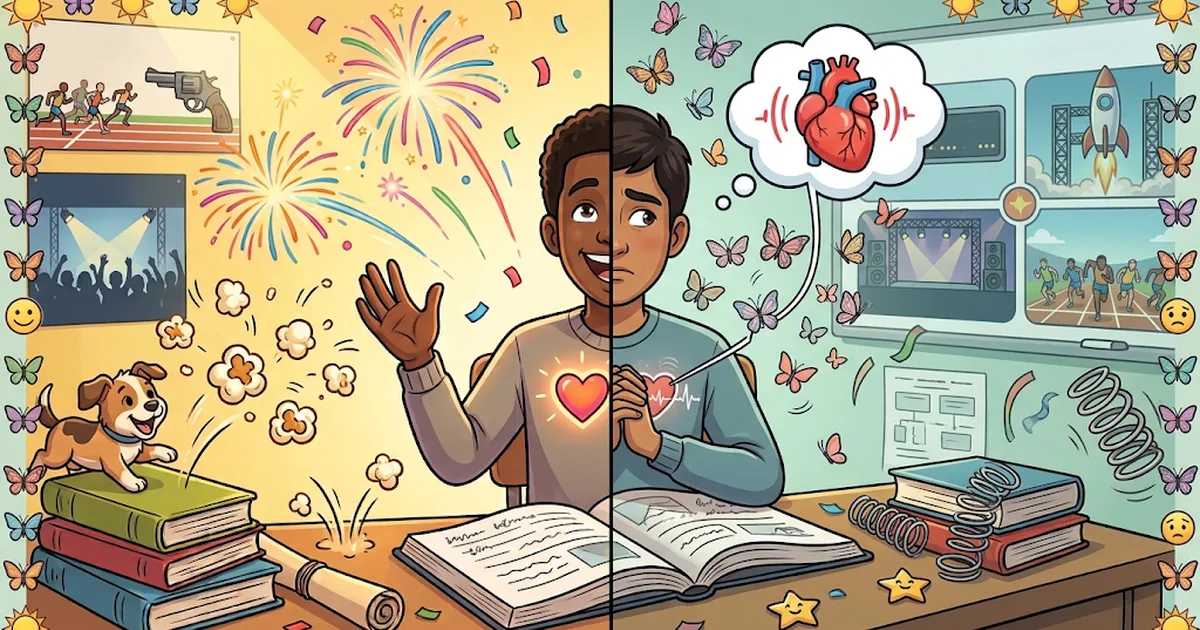
Positive Excitement
This type of excitement feels mostly happy and joyful.
Examples:
- Like fireworks in the sky
- As happy as a child opening a gift
- Like sunshine breaking through clouds
- As joyful as children on a snow day
- Like confetti floating through the air
Example: She felt as joyful as children on a snow day when she heard the good news.
Nervous Excitement
This type combines anticipation with worry or tension.
Examples:
- Like a roller coaster before the first drop
- Like butterflies fluttering in my stomach
- As jumpy as popcorn in a hot pan
- Like a drum beating quickly
- As restless as a runner waiting for the starting signal
Example: I felt like I was on a roller coaster before walking onto the stage.
Knowing the difference helps you choose a simile that fits the emotion instead of using the same comparison every time.
Easy Excited Similes for Beginners
If you are new to similes, start with familiar comparisons.
- As excited as a kid at a theme park
- Like a puppy chasing its tail
- As excited as someone opening a gift
- Like popcorn popping in a pan
- Like a rocket taking off
- As bouncy as a spring
- Like fireworks in the night sky
- As eager as a child waiting for a holiday
Example: I was as excited as a kid at a theme park before our trip.
Simple comparisons are often easier to understand and remember.
Funny Similes for Excitement
Funny similes can make your writing more relaxed and entertaining.
- As excited as a dog hearing the word “walk”
- Like popcorn that forgot how to stay in the pan
- As jumpy as a frog on a lily pad
- Like a kid who just found an extra dessert
- As restless as a puppy waiting for dinner
- Like a child who just spotted an ice cream truck
- As energetic as a toddler who skipped nap time
Example: He was as excited as a dog hearing the word “walk” when he saw the hiking trail.
These comparisons are great for casual writing, funny stories, and social media posts.
Powerful Similes for Extreme Excitement
When the emotion is intense, use images that suggest movement, energy, or sudden change.
- Like a rocket blasting into space
- Like fireworks exploding across the sky
- As electric as a thunderstorm
- Like a wave crashing onto the shore
- Like a drum pounding before a big performance
- As energetic as a racecar at full speed
- Like a crowd erupting after a winning goal
Example: Excitement rushed through him like a wave crashing onto the shore.
These similes can add drama to stories and emotional scenes.
Poetic Similes for Excitement
Poetic writing gives you more room to use beautiful and imaginative comparisons.

- Her excitement rose like the morning sun.
- His happiness shimmered like sunlight on water.
- Their laughter floated like confetti through the air.
- Her heart danced like leaves caught in a warm breeze.
- Excitement spread through the room like golden light.
- His smile opened like a flower in spring.
- Joy moved through her like a bright wave of sunlight.
These comparisons are useful for poems, novels, personal essays, and reflective writing.
Excited Similes for Kids
Kids often connect with comparisons involving animals, games, food, toys, and adventures.
- As excited as a kid at a birthday party
- Like a puppy chasing its tail
- As jumpy as popcorn
- Like a monkey swinging through trees
- As bouncy as a trampoline
- Like a rocket shooting into space
- As happy as a child seeing snow
- Like a kitten playing with yarn
Example: The children were as excited as kids at a birthday party when they saw the giant playground.
Similes for Storytelling and Creative Writing
Stories become more interesting when readers can experience what a character feels.
Instead of:
He was very excited about the race.
Try:
His heart raced like a drum as he waited for the starting signal.
Instead of:
She was excited when she saw her friends.
Try:
She ran toward them like a puppy seeing its favorite people.
Instead of:
The crowd was excited.
Try:
The crowd buzzed like a beehive when the singer stepped onto the stage.
The comparisons create movement and emotion without explaining everything directly.
Excited Similes for Essays and School Writing
Similes can make school writing more descriptive without making it difficult to understand.
Instead of:
I was very excited before the competition.
Write:
I felt as excited as a runner waiting for the starting signal before the competition.
Instead of:
Everyone was excited about the trip.
Write:
Everyone was buzzing like a beehive after the teacher announced the trip.
Keep school-writing similes relevant to the topic. One strong comparison is usually better than several forced ones.
Excited Similes for Work and Professional Situations
Excitement also appears in adult and professional situations.
You might feel excited about:
- Starting a new job
- Getting a promotion
- Giving a presentation
- Launching a project
- Receiving good news
- Meeting an important client
- Reaching a career goal
Examples:
She felt like a runner waiting for the starting signal before her first presentation.
He was as excited as a kid opening a gift when he received the promotion.
The team was buzzing like a beehive before the product launch.
These comparisons keep professional writing friendly while still showing emotion.
Excited Similes for Social Media Captions
Short comparisons work especially well in captions.
- Feeling like fireworks today
- Like a kid in a candy store
- Ready to blast off
- My heart is racing like a rocket
- Buzzing with excitement
- Happier than a puppy at playtime
- Like a kid with a new toy
- Heart jumping like popcorn
For social media, choose a short phrase that matches the mood of your photo or announcement.
How to Create Your Own Excited Similes
Creating an original simile does not have to be difficult.
Step 1: Identify the Emotion
Ask yourself what kind of excitement you feel.
Is it happy, nervous, playful, energetic, surprising, or intense?
Step 2: Think of Something Similar
Choose something that behaves in the same way.
For sudden happiness, you might think of fireworks.
For nervous anticipation, you might think of a roller coaster.
Step 3: Connect the Ideas
Use like or as.
For example:
Feeling: nervous excitement
Image: a drum
Simile:
My heart was beating like a drum before the performance.
Step 4: Check the Sentence
Read it aloud. If the comparison feels confusing or forced, choose a simpler image.
Common Mistakes When Writing Excited Similes
Using an unclear comparison

Weak: He was as excited as a complicated machine.
The reader cannot easily connect the machine with excitement.
Better: He was as excited as a child opening a birthday gift.
Repeating the same image
Using fireworks, rockets, or puppies in every paragraph can make the article repetitive. Mix your comparisons with sports, nature, food, weather, music, and everyday situations.
Making the simile too complicated
Simple comparisons often work better.
Better: She was like a rocket ready to launch.
Choosing the wrong emotional tone
A peaceful image may not work for nervous excitement. Make sure the comparison reflects the feeling you are trying to show.
Simile vs. Metaphor for Excitement
A simile and a metaphor both compare things, but they do it differently.
| Simile | Metaphor |
|---|---|
| Uses “like” or “as” | Makes a direct comparison |
| She was like a rocket | She was a rocket of energy |
| His heart raced like a drum | His heart was a drum |
| The crowd was as loud as thunder | The crowd was thunder |
Similes are often easier for beginners because the comparison is clearly signaled.
How Excited Similes Improve Emotional Connection
Readers understand images quickly. When you compare excitement with something familiar, they can imagine the emotion instead of simply reading its name.
Compare:
He was excited about the game.
with:
He was as restless as a runner waiting for the starting signal.
The second sentence gives us a stronger picture. We can imagine the waiting, the energy, and the anticipation.
That is why similes are useful in creative writing. They turn an abstract feeling into something readers can see and understand.
Practice Exercises for Excited Similes
Try changing these plain sentences into similes.
1. I was very excited about the concert.
Possible answer:
I was as excited as a fan waiting for the doors to open.
2. She was excited about the surprise.
Possible answer:
She was like a puppy waiting for its favorite person.
3. The children were excited about the trip.
Possible answer:
The children were as jumpy as popcorn in a hot pan.
Now create your own comparisons using things you see in everyday life.
Best Tips for Making Excited Similes Sound Natural
Keep these tips in mind:
- Choose familiar images.
- Match the simile with the exact type of excitement.
- Keep the comparison clear.
- Avoid using too many similes in one paragraph.
- Use fresh comparisons instead of repeating the same image.
- Read your sentence aloud.
- Use simple language when writing for children.
- Use stronger imagery for dramatic scenes.
- Let the comparison support the sentence instead of taking it over.
A natural simile should make the sentence clearer, not harder to understand.
Conclusion
Similes for feeling excited give writers a simple way to turn an ordinary emotion into a vivid image. Instead of repeatedly saying someone is excited, you can compare that feeling with fireworks, rockets, bouncing springs, playful puppies, racing drums, or children waiting for something special.
The best comparison depends on the situation. Someone waiting for a birthday might be as excited as a child on Christmas morning, while someone preparing for a competition might feel like a runner waiting for the starting signal. If excitement comes with nervousness, a comparison involving butterflies, popcorn, or a roller coaster may describe it better.
You do not need complicated words to create a strong simile. Everyday experiences often make the best comparisons because readers already understand them. Think about what the excitement feels like, find something that behaves in a similar way, and connect the two with like or as.
With a little practice, you can create excited similes that make stories, essays, poems, captions, and everyday conversations more expressive. A well-chosen comparison does more than describe excitement. It helps your reader feel it too.
FAQs
What are the best similes for feeling excited?
Some useful examples are as excited as a child on Christmas morning, like a rocket ready to blast off, as jumpy as popcorn in a hot pan, and like fireworks bursting in the sky.
What is an excited simile?
An excited simile compares the feeling of excitement with something familiar by using like or as.
What is a good simile for extreme excitement?
A strong option is “His excitement exploded like fireworks across the night sky.” It shows a sudden and powerful burst of happiness.
What simile describes nervous excitement?
“My stomach felt like butterflies were fluttering inside it” is a common way to describe excitement mixed with nervousness.
What are some easy excited similes for kids?
Examples include like a puppy chasing its tail, as bouncy as a spring, like a rocket taking off, and as jumpy as popcorn.
What is a funny simile for excitement?
A funny example is “He was as excited as a dog hearing the word walk.” It creates a playful picture of someone becoming instantly energetic.
Can I use excited similes in essays?
Yes. Similes can make essays more descriptive and engaging. Choose comparisons that fit the subject and avoid using too many.
Can excited similes be used in everyday conversation?
Yes. Expressions such as “I feel like a kid in a candy store” can make everyday speech more expressive and show strong enthusiasm.
What is the difference between a simile and a metaphor?
A simile uses like or as to compare two things. A metaphor makes the comparison directly without using those words.
How do I create my own excited similes?
First, identify the kind of excitement you want to describe. Then think of something that shows a similar feeling or behavior. Finally, connect the two with like or as.
Should I use many similes in one paragraph?
No. One strong and natural simile is often more effective than several comparisons packed into the same paragraph.
How can I make my excited similes sound natural?
Use familiar images, keep the comparison easy to understand, match it with the emotion, and avoid forcing a simile into every sentence.
