Introduction
Have you ever read a sentence that painted a clear picture in your mind, such as “The stars sparkled like tiny diamonds” or “She was as calm as the ocean at sunrise”? These vivid comparisons are called similes, and they make writing more interesting, expressive, and memorable.
Learning to write similes is an important part of developing strong language skills. Whether you are a student preparing for school assignments, a teacher planning classroom activities, an English language learner improving grammar, or a parent helping a child practice at home, simile exercises provide an enjoyable way to build creativity and confidence.
Unlike memorizing grammar rules, simile practice encourages you to observe the world around you and describe it in fresh, imaginative ways. Regular practice improves vocabulary, strengthens sentence structure, enhances reading comprehension, and makes stories, essays, and conversations more engaging.
This complete guide explores everything you need to know about simile exercises. You’ll discover easy activities for beginners, creative writing challenges, classroom games, worksheets, quizzes, answer keys, and expert tips that help learners of all ages master similes with confidence.
Quick Answer
Simile exercises are practice activities that teach learners how to compare two different things using the words “like” or “as.” These exercises help students understand figurative language while improving vocabulary, creativity, sentence construction, and descriptive writing. Common simile activities include fill-in-the-blank questions, matching exercises, sentence rewriting, picture prompts, creative writing tasks, quizzes, and storytelling activities. Whether you’re a beginner or an advanced writer, practicing similes regularly makes your writing more vivid, engaging, and easier for readers to imagine.
What Are Simile Exercises?
Simile exercises are educational activities designed to help learners understand and use similes correctly. A simile is a figure of speech that compares two different things using the words like or as.
Instead of simply describing something, similes create a clear mental image by connecting it with something familiar.
For example:
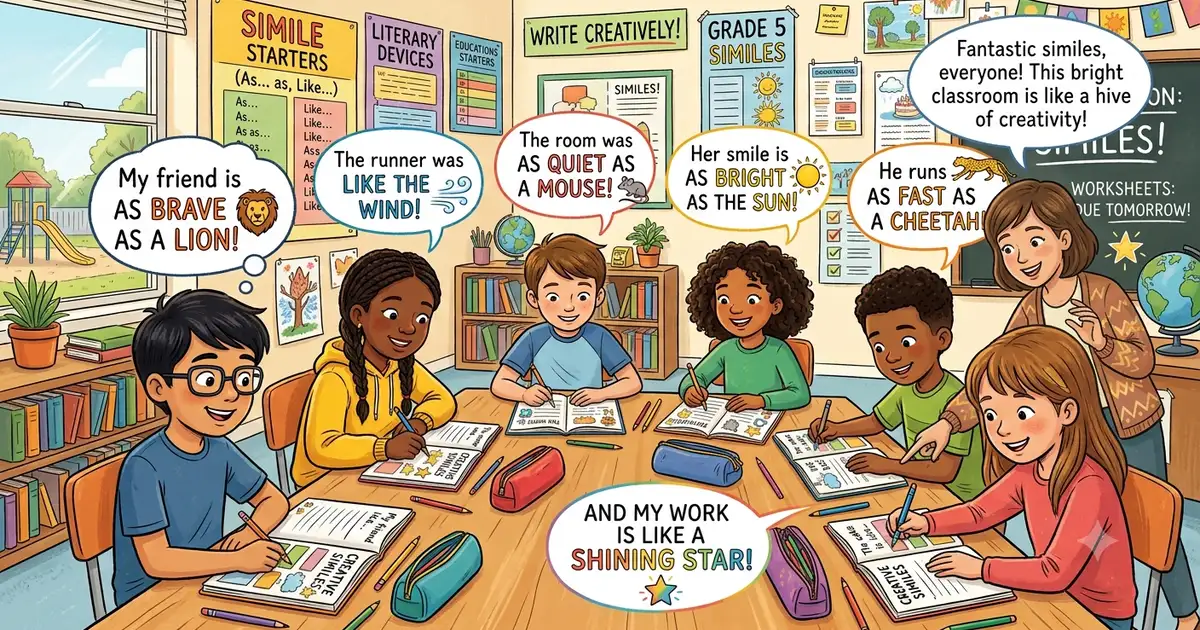
- Her smile was as bright as the sun.
- The baby slept like a peaceful kitten.
- The river flowed like a silver ribbon.
- His voice was as soft as velvet.
- The athlete ran like the wind.
Each comparison helps readers picture the scene more clearly.
Rather than saying someone is “fast,” saying they are “as fast as lightning” creates a stronger impression and makes the sentence more interesting.
Simile exercises teach learners how to create these comparisons naturally and effectively.
Why Are Simile Exercises Important?
Learning similes is about much more than adding decoration to sentences. They help writers communicate ideas clearly while making descriptions more engaging.
Here are some of the biggest benefits.
Improve Creative Thinking
Similes encourage learners to think beyond ordinary descriptions.
Instead of writing:
The cake tasted good.
You can write:
The cake tasted like a slice of heaven.
The second sentence creates a much stronger image.
Expand Vocabulary
Every new simile introduces learners to descriptive words and expressions.
For example:
Instead of always saying:
- beautiful
- fast
- cold
- bright
Students learn comparisons such as:
- as beautiful as a rainbow
- as fast as a cheetah
- as cold as ice
- as bright as the morning sun
Over time, vocabulary grows naturally.
Make Writing More Interesting
Readers enjoy writing that creates pictures in their minds.
Compare these examples.
Plain sentence:
The garden looked beautiful.
Simile:
The garden looked like a colorful painting filled with flowers.
The second sentence is far more vivid and memorable.
Improve Reading Comprehension
Many stories, poems, novels, and speeches use figurative language.
Students who understand similes can understand literature more easily and recognize the author’s intended meaning.
Build Confidence
Simple simile exercises allow learners to practice without fear of making mistakes.
As confidence grows, students naturally begin using similes in essays, stories, presentations, and everyday conversations.
Benefits of Practicing Similes Regularly
Practicing similes consistently provides long-term language benefits.
| Benefit | How It Helps |
|---|---|
| Better Writing | Makes sentences colorful and descriptive |
| Larger Vocabulary | Introduces expressive words and comparisons |
| Improved Reading | Helps understand figurative language in books |
| Stronger Creativity | Encourages original thinking |
| Better Storytelling | Makes stories exciting and memorable |
| Speaking Skills | Creates more engaging conversations |
| Essay Writing | Adds depth and detail to descriptions |
| Poetry Skills | Improves imagery and rhythm |
| Language Confidence | Makes learners more comfortable expressing ideas |
Even practicing for just ten minutes each day can noticeably improve descriptive writing over time.
Types of Simile Exercises
There are many ways to practice similes, and each type builds a different language skill.
| Exercise Type | Skill Developed | Difficulty |
|---|---|---|
| Fill in the Blank | Vocabulary | Easy |
| Matching Exercise | Understanding Meaning | Easy |
| Multiple Choice | Recognition | Easy |
| Sentence Completion | Grammar | Easy |
| Picture Prompt | Observation | Medium |
| Story Writing | Creativity | Medium |
| Paragraph Rewriting | Descriptive Writing | Medium |
| Simile vs. Metaphor | Figurative Language | Medium |
| Quiz | Review | Medium |
| Original Simile Creation | Creative Thinking | Advanced |
Using a variety of exercises keeps learning enjoyable while strengthening multiple language skills.
How Simile Exercises Improve Everyday Writing
Many learners think similes are only useful in poetry, but they improve nearly every type of writing.
For example:
Without a simile:
The mountain was tall.
With a simile:
The mountain stood like a giant guarding the valley.
Without a simile:
The classroom was quiet.
With a simile:
The classroom was as quiet as a library at midnight.
Without a simile:
The coffee was hot.
With a simile:
The coffee was as hot as fresh lava.
Each revised sentence helps readers visualize the scene instantly.
Easy Simile Exercises for Beginners
If you’re just starting, begin with simple comparisons that describe everyday objects, animals, weather, food, or emotions.
Exercise 1: Complete the Simile
Finish each sentence.
- The snow is as white as ________.
- The baby sleeps like ________.
- The rabbit is as quick as ________.
- My pillow is as soft as ________.
- The stars shine like ________.
- The soup is as hot as ________.
- My backpack feels as heavy as ________.
- The flowers smell as sweet as ________.
- The lake is as calm as ________.
- The bird sings like ________.
Sample Answers
- milk
- a kitten
- lightning
- cotton
- diamonds
- fire
- a rock
- perfume
- glass
- a flute
Remember that many answers can be correct if they create a clear and meaningful comparison.
Fill-in-the-Blank Simile Practice
Choose a word that best completes each simile.
Exercise A
The moon looked like a __________.
A. sandwich
B. silver coin
C. pencil
The classroom was as quiet as __________.
A. thunder
B. a library
C. fireworks
His hands were as cold as __________.
A. sunshine
B. ice
C. bread
The child laughed like __________.
A. ringing bells
B. bricks
C. smoke
The lion was as brave as __________.
A. paper
B. a warrior
C. butter
Answer Key
- Silver coin
- A library
- Ice
- Ringing bells
- A warrior
Match the Simile to Its Meaning
Draw a line between the simile and its meaning.
| Simile | Meaning |
|---|---|
| As busy as a bee | Works very hard |
| As cool as a cucumber | Calm under pressure |
| Like a fish out of water | Feels uncomfortable |
| As light as a feather | Very light |
| As stubborn as a mule | Refuses to change |
Answers
- As busy as a bee → Works very hard
- As cool as a cucumber → Calm under pressure
- Like a fish out of water → Feels uncomfortable
- As light as a feather → Very light
- As stubborn as a mule → Refuses to change
Expert Tips for Mastering Similes
Learning similes becomes easier when you develop the habit of observing the world around you.
Keep these simple tips in mind:
- Read books that use descriptive language.
- Notice comparisons in songs, movies, and poems.
- Practice writing five new similes every day.
- Replace ordinary adjectives with creative comparisons.
- Observe nature for inspiration.
- Avoid using the same similes repeatedly.
- Focus on creating original comparisons that fit the context.
The more you practice, the more naturally similes will become part of your writing style.
Simile Exercises That Improve Writing and Language Skills (Complete Practice Guide for 2026) –
In Part 1, you learned what simile exercises are, why they matter, and how beginners can start practicing. Now it’s time to take your skills to the next level with more engaging activities, classroom exercises, and creative writing challenges.
Intermediate Simile Exercises
Once you understand basic similes, the next step is learning how to create comparisons that feel natural and meaningful. These exercises encourage you to think more creatively and expand your descriptive writing.
Exercise 1: Complete the Simile
Choose the best word or phrase to complete each sentence.
- The clouds floated like __________.
- Her eyes sparkled like __________.
- The old house stood as silent as __________.
- The child was as curious as __________.
- The river twisted like __________.
- His laughter echoed like __________.
- The leaves danced like __________.
- My grandfather is as wise as __________.
- The classroom buzzed like __________.
- The diamond shone like __________.
Sample Answers
- feathers
- stars
- a forgotten castle
- a little explorer
- a winding snake
- thunder in the mountains
- butterflies
- an old owl
- a beehive
- crystal
Remember, there can be more than one correct answer if the comparison makes sense.
Multiple-Choice Simile Practice
Read each sentence and choose the best answer.
1. The baby’s skin was as soft as ________.
A. stone
B. silk
C. wood
✅ Answer: B. silk
2. The runner was as fast as ________.
A. lightning
B. pillow
C. chair
✅ Answer: A. lightning
3. The soup was as hot as ________.
A. snow
B. fire
C. rain
✅ Answer: B. fire
4. The classroom was as quiet as ________.
A. a library
B. a concert
C. fireworks
✅ Answer: A. a library
5. The stars shone like ________.
A. diamonds
B. shoes
C. leaves
✅ Answer: A. diamonds
Rewrite Simple Sentences Using Similes
Transform each plain sentence into a more descriptive one by adding a simile.
Example
Plain Sentence
The flowers are beautiful.
With a Simile
The flowers are as beautiful as a rainbow after the rain.
Practice
- The dog is friendly.
- The cake tastes delicious.
- The boy is brave.
- The water is cold.
- The teacher is kind.
- The mountain is tall.
- The girl is happy.
- The road is long.
- The music is relaxing.
- The sky is blue.
Sample Answers
- The dog is as friendly as a puppy.
- The cake tastes like a sweet dream.
- The boy is as brave as a lion.
- The water is as cold as ice.
- The teacher is as kind as an angel.
- The mountain is as tall as a giant.
- The girl is as happy as a child on Christmas morning.
- The road stretched like a ribbon.
- The music flowed like a gentle stream.
- The sky was as blue as the ocean.
Match the Simile With Its Meaning
Draw a line to connect each simile with its correct meaning.
| Simile | Meaning |
|---|---|
| As blind as a bat | Cannot see well |
| As gentle as a lamb | Very kind and calm |
| As proud as a peacock | Very proud |
| Like a bolt from the blue | Completely unexpected |
| As free as a bird | Independent and unrestricted |
| Like finding a needle in a haystack | Extremely difficult |
| As hungry as a wolf | Very hungry |
| As slow as a snail | Very slow |
Answer Key
- As blind as a bat → Cannot see well
- As gentle as a lamb → Very kind
- As proud as a peacock → Proud
- Like a bolt from the blue → Unexpected
- As free as a bird → Independent
- Like finding a needle in a haystack → Very difficult
- As hungry as a wolf → Extremely hungry
- As slow as a snail → Very slow
Picture-Based Simile Exercises
Pictures encourage learners to think creatively. Look at an image and write your own simile.
Example 1
Picture: A rainbow over mountains
Possible similes:
- The rainbow stretched like a colorful bridge.
- The rainbow was as bright as a painter’s masterpiece.
Example 2
Picture: A roaring waterfall
Possible similes:
- The waterfall thundered like a mighty drum.
- The water rushed like racing horses.
Example 3
Picture: A sleeping kitten
Possible similes:
- The kitten slept like a tiny angel.
- The kitten was as peaceful as a quiet morning.
Simile vs. Metaphor Exercises
Many students confuse similes with metaphors. The difference is simple.
| Simile | Metaphor |
|---|---|
| Uses like or as | Does not use like or as |
| Makes a comparison | States something directly |
Examples
Simile
Her smile was like sunshine.
Metaphor
Her smile was sunshine.
Identify the Figure of Speech
Write Simile or Metaphor.
- He is as strong as an ox.
- My brother is a rock.
- The clouds were like cotton.
- Time is a thief.
- She sings like a bird.
- The classroom was a zoo.
- The wind howled like a wolf.
- Her voice is music.
Answers
- Simile
- Metaphor
- Simile
- Metaphor
- Simile
- Metaphor
- Simile
- Metaphor
Create Your Own Similes
Original similes make writing more engaging.
Complete these sentence starters.
- My best friend is as __________ as __________.
- The moon looked like __________.
- My backpack felt as heavy as __________.
- The playground sounded like __________.
- The sunset looked like __________.
- My pet runs like __________.
- The beach was as peaceful as __________.
- The wind sounded like __________.
- The cake smelled like __________.
- My little brother laughed like __________.
There are no single correct answers. Creativity is encouraged.
Simile Story Challenge
Read the paragraph below.
The little girl walked through the forest. The trees were tall. Birds sang in the branches. The wind moved through the leaves.
Now improve it by adding similes.
Example
The little girl walked through the forest. The trees stood like giant guardians watching over the path. Birds sang like tiny musicians, while the wind whispered like an old friend through the leaves.
Notice how similes create vivid imagery and make the paragraph more enjoyable to read.
Daily Simile Writing Challenge
Practice one new simile each day using the following prompts.
Monday
Write three similes about weather.
Tuesday
Describe your favorite animal using five similes.
Wednesday
Write four similes about food.
Thursday
Describe your school with five original similes.
Friday
Write a short paragraph using at least six similes.
Saturday
Read a story and find ten similes.
Sunday
Write your own short story using ten original similes.
Practicing a little each day builds strong writing habits.
Fun Classroom Games for Simile Practice
Teachers can make learning exciting with interactive activities.
Simile Charades
One student acts out a simile while classmates guess the comparison.
Example:
“As slow as a snail.”
Simile Relay Race
Teams compete to complete unfinished similes within a time limit.
Example:
“As cold as ______.”
Mystery Object Game
Place an object inside a bag. Students feel it without looking and describe it using similes.
Example:
“It feels as smooth as glass.”
Story Circle
One student begins a story using a simile. Each student adds another sentence containing a new simile until the story is complete.
Simile Treasure Hunt
Students walk around the classroom or playground and write similes describing objects they find.
Example:
“The leaves are as green as emeralds.”
Why Variety Matters in Simile Practice
Repeating the same exercise every day can become boring. Mixing different activities helps learners stay motivated while strengthening multiple language skills at once.
For example:
- Fill-in-the-blank exercises improve vocabulary.
- Matching activities strengthen understanding.
- Story writing builds creativity.
- Picture prompts develop observation skills.
- Quizzes improve memory.
- Group games encourage communication.
- Sentence rewriting improves descriptive writing.
Using a combination of these methods leads to faster progress and greater confidence.
Simile Exercises That Improve Writing and Language Skills (Complete Practice Guide for 2026)
In Parts 1 and 2, you learned the basics of similes and practiced through fill-in-the-blank activities, matching exercises, rewriting tasks, and classroom games. In this part, you’ll explore age-specific activities, creative writing worksheets, homework exercises, and advanced practice designed to build confidence and imagination.
Simile Exercises for Elementary Students
Elementary students learn best through simple, fun, and engaging activities. The goal is to help them understand how similes create vivid mental images without making lessons feel difficult.
Exercise 1: Complete the Simile
Fill in the blanks with a word or phrase that makes sense.
- The puppy is as playful as __________.
- My blanket is as warm as __________.
- The flower smells like __________.
- The moon is as bright as __________.
- The turtle moves like __________.
Sample Answers
- a clown
- a cozy hug
- fresh perfume
- a shining lantern
- a tiny snail
Exercise 2: Circle the Simile
Read each sentence and identify the simile.
- The wind sounded like a whistle.
- The tree is very tall.
- Her eyes were as blue as the ocean.
- The book is interesting.
- The soup tasted delicious.
Answers
- Sentence 1
- Sentence 3
Exercise 3: Draw and Describe
Draw one of the following and write a simile about it.
- A rainbow
- A bird
- A puppy
- A tree
- A snowman
Example
“The rainbow looked like a colorful bridge across the sky.”
This activity combines creativity with language learning.
Simile Exercises for Middle School Students
Middle school learners can write longer descriptions and experiment with original ideas.
Rewrite the Sentence
Turn these simple sentences into descriptive ones using similes.
Example
Original
The river moved quickly.
Improved
The river rushed like a wild horse.
Now rewrite these:
- The classroom was noisy.
- The mountain was tall.
- My grandmother is kind.
- The athlete is fast.
- The stars are bright.
Sample Answers
- The classroom buzzed like a busy marketplace.
- The mountain stood like a giant watching the valley.
- My grandmother is as kind as sunshine.
- The athlete ran like lightning.
- The stars sparkled like tiny diamonds.
Simile Exercises for High School Students
Older students should practice creating fresh and meaningful comparisons instead of relying on common similes.
Descriptive Writing Challenge
Write one original simile for each topic.
- Hope
- Fear
- Friendship
- Success
- Failure
- Winter
- Summer
- Time
- Dreams
- Memories
Example
Hope
“Hope shines like the first sunrise after a long storm.”
Time
“Time slips away like sand through open fingers.”
Encourage originality instead of copying familiar expressions.
Simile Exercises for English Language Learners (ESL)
English learners benefit from simple vocabulary and everyday examples.
Match the Words
Connect each object with the most suitable simile.
| Word | Simile |
|---|---|
| Ice | As cold as ice |
| Feather | As light as a feather |
| Bee | As busy as a bee |
| Lion | As brave as a lion |
| Owl | As wise as an owl |
After matching, use each simile in a complete sentence.
Sentence Practice
Complete each sentence.
- She sings like __________.
- My brother eats like __________.
- The room was as quiet as __________.
- The soup is as hot as __________.
- The lake is as calm as __________.
These simple exercises improve both grammar and vocabulary.
Creative Writing Exercises Using Similes
Creative writing becomes much more engaging when writers use similes naturally.
Exercise: Describe the Seasons
Write at least three similes for each season.
Spring
Example:
“Flowers opened like colorful umbrellas after the rain.”
Summer
Example:
“The sunshine felt as warm as a soft blanket.”
Autumn
Example:
“Leaves floated like golden butterflies.”
Winter
Example:
“Snow covered the ground like a white quilt.”
Storytelling Practice
Read the short paragraph below.
Before
The boy entered the cave. It was dark and quiet. He felt afraid.
After
The boy entered the cave. It was as dark as midnight, and the silence hung like a heavy blanket. His heart pounded like a drum as he took another step.
Notice how the second paragraph creates stronger imagery and emotion.
Paragraph Expansion Exercise
Expand this paragraph by adding at least five original similes.
Starter Paragraph
The park was beautiful. Children played happily. Birds flew through the trees. The wind moved gently across the grass.
Sample Expansion
The park was as colorful as a painter’s canvas. Children laughed like cheerful bells, while birds floated like tiny airplanes through the trees. The wind whispered like a gentle song, and the grass waved like green ocean waves.
Homework Simile Practice
Practice a little every day.
Monday
Write five similes describing your home.
Tuesday
Describe your favorite meal using five similes.
Wednesday
Write five similes about animals.
Thursday
Describe your classroom.
Friday
Write a short story containing ten original similes.
Saturday
Find ten similes while reading a book.
Sunday
Review all your work and improve your weakest similes.
Printable Simile Worksheet
Part A: Fill in the Blanks
- The moon is as bright as __________.
- The road twisted like __________.
- The kitten slept like __________.
- The ocean was as calm as __________.
- His smile was as bright as __________.
Part B: Identify the Simile
Write Yes if the sentence contains a simile.
- The cake tasted like heaven.
- The sun is hot.
- She danced like a butterfly.
- The mountain is huge.
- The baby is as quiet as a mouse.
Part C: Create Your Own
Write your own similes about:
- A rainy day
- A rainbow
- Your best friend
- Your teacher
- Your favorite sport
Worksheet Answer Key
Part A
Possible answers:
- the sun
- a snake
- a baby
- glass
- sunshine
Part B
- Yes
- No
- Yes
- No
- Yes
Editing Practice
Improve these weak similes.
Weak
The water was like water.
Better
The water was as clear as crystal.
Weak
The dog ran like running.
Better
The dog ran like the wind.
Weak
She smiled like smiling.
Better
She smiled like the morning sun.
Weak
The cake tasted good.
Better
The cake tasted like a slice of heaven.
Weak
The forest was quiet.
Better
The forest was as silent as a sleeping giant.
Challenge Yourself
Can you write one original simile for each of these?
- Happiness
- Anger
- Rain
- Snow
- Fire
- Friendship
- Music
- Ocean
- School
- Family
Try to avoid common comparisons and create something unique.
Tips for Students
If you want to become better at writing similes, follow these habits:
- Read stories and poems regularly.
- Keep a notebook of interesting similes.
- Observe nature and everyday life for inspiration.
- Replace ordinary adjectives with descriptive comparisons.
- Practice writing at least five new similes every day.
- Ask a teacher or friend to review your work.
- Revise your similes to make them more original and meaningful.
Small daily improvements can make a big difference in your writing over time.
Simile Exercises That Improve Writing and Language Skills (Complete Practice Guide for 2026)
Welcome to the final part of this complete guide. By now, you’ve learned the basics of similes, practiced with beginner and intermediate exercises, and explored activities for different age groups. This final section will help you master similes through advanced practice, expert techniques, a comprehensive quiz, and over 100 ready-to-use examples.
Advanced Simile Exercises for Creative Writers
Advanced simile exercises focus on originality rather than memorizing common comparisons. The goal is to create fresh imagery that helps readers visualize ideas in new ways.
Exercise 1: Describe Emotions
Write an original simile for each emotion.
- Joy
- Fear
- Anger
- Excitement
- Loneliness
- Hope
- Pride
- Surprise
Example Answers
- Joy: My happiness spread like sunshine after a week of rain.
- Fear: Fear crept through me like a cold shadow at night.
- Hope: Hope grew like the first flower of spring.
Exercise 2: Improve These Sentences
Replace the plain descriptions with vivid similes.
Original
The wind was strong.
Better
The wind roared like a freight train.
Original
The lake was calm.
Better
The lake was as smooth as polished glass.
Original
The child laughed loudly.
Better
The child laughed like cheerful bells ringing through the air.
Common Mistakes Students Make
Many learners make the same mistakes when writing similes. Understanding these errors will help you write more naturally.
| Mistake | Incorrect Example | Better Example |
|---|---|---|
| Missing like or as | He fast as lightning | He is as fast as lightning |
| Comparing unrelated things | She sings like homework | She sings like a nightingale |
| Using overused similes repeatedly | As busy as a bee (every paragraph) | Create fresh comparisons |
| Mixing literal and figurative meaning | The rock is like hard | The rock is as hard as steel |
| Incomplete comparison | She is like beautiful | She is as beautiful as a rose |
How to Create Original Similes
Original similes make your writing memorable. Follow these steps:
1. Observe the World Around You
Pay attention to nature, weather, people, animals, and everyday objects.
2. Think About the Main Quality
Ask yourself what stands out.
Is it:
- Fast?
- Bright?
- Quiet?
- Gentle?
- Strong?
3. Find Something Similar
Choose an object, animal, or experience that shares the same quality.
Example:
Quality: Bright
Comparison: A lighthouse
Simile: Her smile was as bright as a lighthouse on a dark coast.
4. Keep It Clear
A good simile should help readers understand your meaning instantly.
100+ Ready-to-Use Simile Examples
Here are more than 100 similes organized by category for inspiration.
Nature
- As calm as a quiet lake
- As bright as the morning sun
- Like leaves dancing in the wind
- As fresh as spring rain
- Like waves rolling onto the shore
- As gentle as a summer breeze
- As colorful as a rainbow
- Like snow covering the mountains
- As peaceful as a forest at dawn
- Like stars scattered across the sky
Animals
- As brave as a lion
- As busy as a bee
- As wise as an owl
- As quick as a rabbit
- As graceful as a swan
- As playful as a puppy
- As quiet as a mouse
- As stubborn as a mule
- As proud as a peacock
- As strong as an ox
Weather
- As cold as ice
- Like thunder rolling through the hills
- As warm as sunshine
- Like rain tapping on a window
- As bright as lightning
- Like clouds floating across the sky
- As gentle as falling snow
- Like a rainbow after the storm
- As clear as a sunny morning
- Like fog covering the valley
Feelings
- As happy as a child at a birthday party
- As lonely as a deserted island
- As excited as a kid opening presents
- As nervous as a bird in a storm
- As proud as a champion
- As calm as still water
- As hopeful as the first sunrise of spring
- Like a heart full of music
- As peaceful as a sleeping baby
- As cheerful as birds at dawn
Everyday Objects
- As soft as cotton
- As smooth as silk
- As sharp as a razor
- As light as a feather
- As heavy as a boulder
- As clear as crystal
- As shiny as a mirror
- Like a ribbon in the wind
- As clean as new glass
- As bright as a polished coin
Tip: Use these as inspiration, but try creating your own unique comparisons whenever possible.
Simile Quiz
Test what you’ve learned.
Multiple Choice
1. Which sentence contains a simile?
A. The sun is a giant fireball.
B. The sun shone like gold.
C. The sun disappeared.
Answer: B
2. Which word usually appears in a simile?
A. Because
B. Like
C. Since
Answer: B
3. Which sentence is a metaphor?
A. He runs like the wind.
B. She is as brave as a lion.
C. He is a rock.
Answer: C
4. Complete the sentence.
The stars sparkled like ________.
A. diamonds
B. books
C. tables
Answer: A
5. Which simile is the most original?
A. As cold as ice.
B. As bright as the sun.
C. Her ideas spread like colorful fireworks across the night sky.
Answer: C
Teacher Tips
Teachers can make simile lessons more engaging by:
- Using real-life objects during lessons.
- Encouraging group discussions.
- Reading books rich in figurative language.
- Displaying a “Simile of the Week.”
- Organizing classroom writing contests.
- Letting students illustrate their similes.
- Reviewing examples from famous authors.
- Giving positive feedback on original ideas.
Parent Tips
Parents can help children practice similes at home by:
- Reading bedtime stories together.
- Asking children to describe objects using similes.
- Playing word games during car rides.
- Encouraging journal writing.
- Praising creativity rather than perfection.
- Watching nature and discussing comparisons.
- Creating a family “simile notebook.”
Why Simile Practice Matters
Regular practice helps learners:
- Write more vivid stories.
- Build stronger vocabulary.
- Improve reading comprehension.
- Understand figurative language.
- Develop creative thinking.
- Speak with greater confidence.
- Express emotions more clearly.
- Enjoy writing more.
Like any skill, improvement comes through consistent practice.
Conclusion
Simile exercises are one of the most effective ways to improve writing, expand vocabulary, and develop creative thinking. Whether you’re completing simple fill-in-the-blank activities, rewriting sentences, crafting original comparisons, or using similes in stories, every exercise strengthens your ability to communicate with clarity and imagination.
The key to mastering similes is consistent practice. Read widely, observe the world around you, and challenge yourself to create fresh, meaningful comparisons instead of relying only on familiar expressions. Over time, you’ll find that your writing becomes more vivid, engaging, and memorable.
No matter your age or skill level, simile exercises can transform the way you express ideas. Start with simple comparisons, practice regularly, and enjoy the journey toward becoming a more confident and creative writer.
Frequently Asked Questions
What are simile exercises?
Simile exercises are activities that teach learners how to compare two different things using like or as. They help improve descriptive writing, vocabulary, and creativity.
Why are simile exercises important?
They encourage creative thinking, strengthen language skills, and make writing more engaging and memorable.
Who can use simile exercises?
Students, teachers, parents, homeschoolers, English language learners, and anyone who wants to improve writing can benefit from simile practice.
What words are commonly used in similes?
Most similes use the words like and as to make comparisons.
What’s the difference between a simile and a metaphor?
A simile compares using like or as, while a metaphor makes a direct comparison without those words.
How often should I practice similes?
Practicing for 10–15 minutes a day is enough to build confidence and improve writing over time.
Are simile worksheets useful?
Yes. Worksheets provide structured practice, reinforce learning, and are ideal for classrooms and self-study.
Can similes improve storytelling?
Absolutely. Similes create vivid imagery, making stories more engaging and emotionally impactful.
How do I create my own similes?
Start by identifying a quality—such as speed, beauty, or strength—and compare it with something familiar that shares the same characteristic.
What are some common similes?
Examples include as brave as a lion, as busy as a bee, as light as a feather, and as cold as ice.
